Drone pilots are leading the fight in eastern Ukraine. How does remote-controlled war affect soldiers?
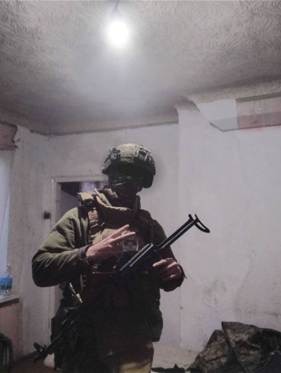
Drop in a posed photo. Source: Drop.
By Kenny Khoo
The car sped down a straight road towards Pokrovsk. The town in eastern Ukraine is only 12 square miles, but Russian forces had been trying to capture it for more than a year since nearby Avdiivka fell in July 2024.
Drop sat on the passenger side of the car and saw explosions a few hundred meters straight ahead. A drone operator, he earned his nickname dropping bombs on Russian troops. As Pokrovsk inched closer into view, so did the explosions and the now unmistakable metallic whine in the air. Drop knew what was going to happen.
“Mate, get ready to jump out of the car because if there’s a drone up ahead it’s gonna hit us,” Drop told his driver.
The Russians flying those drones were skilled: the premier team, as Drop calls them. Even as explosions rained around the desperately speeding car, Drop had to hand it to the Russians, from one drone pilot to another. The pilots, wherever they were holed up in Pokrovsk, had sent four waves of kamikaze drones, each swarm coming in five-minute intervals, so the skies were never clear. The drones kept crashing down like exploding hailstones.
But somehow, none of the drones hit Drop’s car. He and the driver sped into Pokrovsk and made it to the Ukrainian lines.
Modern warfare
Drones have been central to the Ukraine war since Russia’s invasion in 2022. But piloting drones has only gotten more dangerous since spring, when both sides prioritized the killing of enemy drone operators. The Ukrainian military, which has a reward system for its drone pilots, doubled the points operators would get from killing their Russian counterparts from six to 12.
Russia is tight-lipped about its counter-drone operations. But Ukrainian drone pilots know they are being hunted. They believe the Russian military has set up specialized drone units staffed with the best pilots.
“We were getting hit with maybe two (drones) a day or every couple of days,” said Drop. “And then in the last six months we were getting close to 30 plus a day.”
It is a strange time to be a soldier on the frontlines. Whether one is in the Russian or Ukrainian military, a soldier now has to be more wary of a drone than a bullet. Military observers estimate up to 70 percent of all casualties in the war have been caused by the small unmanned vehicles.
This technology presents a duality in the art of war. The pilot can hover over a soldier, study the target through the camera, then drop a bomb on him and watch it explode. Visually, the process is more intimate than peeking behind cover to shoot an enemy whose face you can barely see. Yet, this act of killing occurs on a screen no larger than a laptop, viewed from a safe distance.
An act of killing
“I don’t really remember the first guy I killed. To be honest, it was a pretty underwhelming experience.”
Drop pushed a button on a remote. Some kilometers away outside his bunker in Pokrovsk, a drone released its grip on a grenade which fell on an unsuspecting Russian soldier below.
It was March 2024. Drop, at 30 years old and freshly posted to the 25th Airborne Brigade, was making his first kill.
Fear, joy, resentment, confusion. He felt every emotion as the grenade exploded. In a sense, the death he was about to witness was exactly what he came to Ukraine for. He flew to the country right after serving six years in the Australian military because he believed he had an obligation to stop Russia’s invasion.
But as the Russian soldier died in a cloud of shrapnel and dirt, Drop realized he felt something else – nothing. The excitement of combat faded and gave way to a void in his emotional core.
“I didn’t feel anything… After that happens, you sort of wonder to yourself, is that how you are meant to feel? Is this normal? But to be honest, I don’t really have any problems doing it,” said Drop.
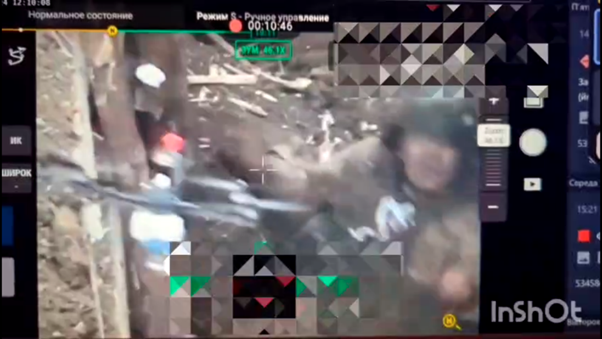
A kamikaze drone flies towards a Russian soldier in a trench. Video courtesy of Drop.
Drop knows drone pilots who are not as unaffected by their work as he is. Some of his platoon mates have nightmares about the people they have killed. As for himself, Drop justified his detachedness with psychology.
“The psychological trauma that killing takes on people, it depends on the proximity to who they kill,” says Drop.
“They (Russian soldiers) are writhing around on the ground or begging for help or, you know, trying to crawl away or whatever it is. But it’s not as visceral as being there in the flesh and hearing it with your own ears or seeing it with your eyes.”
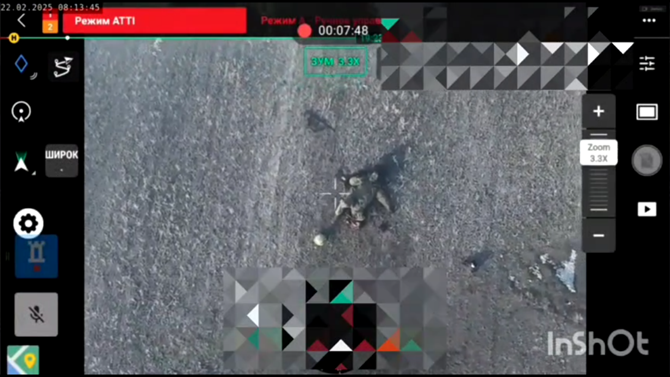
An injured Russian soldier lying on a field after a drone attack. Video courtesy of Drop.
Close calls
In the months since Drop’s first near-death experience on the road to Pokrovsk, Russians have sent more troops, artillery and drones towards taking the logistics center. Drop faced the second near-miss attempt on his life when a swarm of Russian drones struck his bunker.
The shelter itself was not breached. But Drop wanted to check on the civilians living in the area. So he opened the door, took a step outside, and was greeted by a drone coming straight above his head. It struck the face of the building just 50 meters above him and exploded. The concussive blast of the explosion rattled through Drop.
He tumbled back into the bunker and sat down on a step. Did any shrapnel hit him? Drop checked his body. No, he was not hit. Was his Russian counterpart aiming the drone at him? If so, they failed this time. But in Pokrovsk, the Russians will never stop hunting him.
“When you survive something like that, the feeling of relief is immense,” said Drop.
“It’s kind of hard to explain. You have to experience it.”