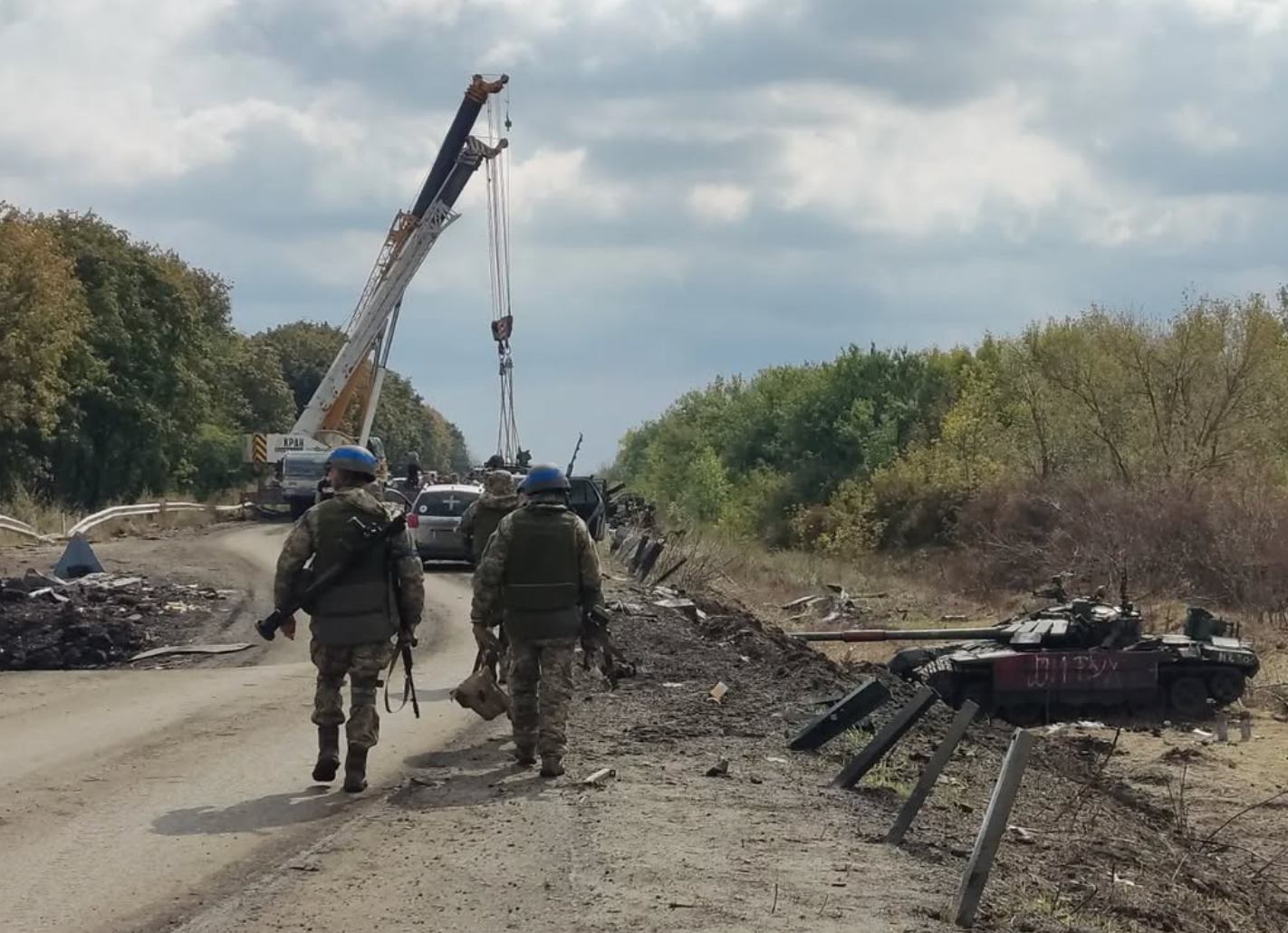
Foreign Fighters from France after Izium’s counter-offensive, Ukraine, September 2022
Source: Call_Sign_Vito, Instagram
From Rojava to Kyiv, foreign volunteers redefine what it means to be a combatant in a war that was never meant to be theirs.
By Yevheniia Yefymova
It was in the tunnels of Kurdistan, Northern Iraq, that Corey watched the invasion of Ukraine unfold on a small TV screen on February 24th, 2022. Instantly, he knew where he wanted to be next: in Ukraine. And he wasn’t alone.
“Someone started a chat,” Corey told me. “He invited the others, they invited their people, and suddenly it was twenty of us heading to Poland.” Within a week, he landed in Krakow, Poland, with around twenty other international volunteers, veterans of wars in Syria and Iraq, on their way to join a territorial defense unit in Ukraine.
Every foreign fighter I’ve spoken to described a similar memory – when Ukraine became their next war.
American veteran Josh mentioned how“Some old work friends and I messaged, thinking the same things I was thinking.” Sebastien, an officer from Chile, told himself, “I just need to go to Poland, and from Poland, I would find a way to Kyiv.” French soldier JB had packed months earlier because his friends in the Azov Regiment gave him a warning. “And what seemed like the snap of a finger, we were contracted with the Ukrainian military,” Josh recalls.
Their stories are shared across social media. Ukraine’s open call to foreign volunteers, amplified by Telegram channels, Instagram reels, and the official International Legion, created the image of a global brotherhood. I found JB through a collaboration post with the Legion, and it led me to find others: Corey, known online as CivDiv on Instagram and YouTube, Josh, who followed Corey’s account, while Sebastien and Troy surfaced in the suggested profiles.
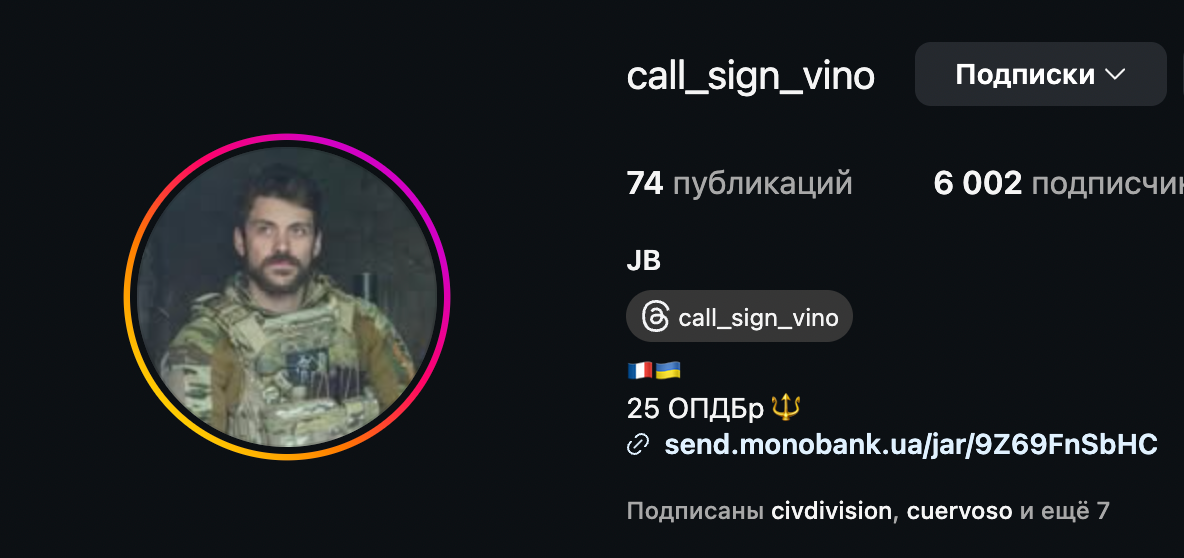
This article uses the names of the interviewees from their social media aliases and preferred names
Yet, all I’ve spoken to decided to stay away from the Legion, and joined other troops – Special Forces, Azov, or training. What outsiders imagine as one global “volunteer community” is, in reality, small, scattered clusters – micro-communities that rely on past wars, and what makes them reappear are personal motivations to fight again.
OPEN CALL
The scale of the news from Ukraine has attracted over 20,000 foreigners to enter the fight. “It’s a Wild West…No matter what war it is,” says Corey.
Foreign Fighters come for all sorts of reasons, and one thing Corey and Sebastien learned is to stay away from the surge of foreigners. Those who Sebastien describes as “LARPers”, referring to foreign fighters in non-combat zones, “war tourists” coming to Ukraine claiming they’re warfighters.
The International Legion – Ukraine’s open call for foreign volunteers – was theoretically the most legitimate route in. But almost every fighter I spoke to refused to join it – their personal connections provided a more reliable path.
“I don’t trust the commanders there,” Sebastien explained, describing a leadership still shaped by Soviet-style leadership. He adds that the Legion is made up of “Colombians, Peruvians, Brazilians” – 50-60% volunteers who come primarily for economic reasons, sitting on the edge between foreign volunteers and outright mercenaries.
TrackANaziMerc is a Russian-based Telegram channel
posting POWs or Murdered soldiers on the Ukrainian side
BECOMING A COMBATANT
In Kyiv, as Corey walked off the train, the first person he saw was Kamal, an old comrade from Syria. “The world is small,” Corey said. “Especially for us.”
Corey joined the People’s Defense Unit (YPG) in Northern Syria back in 2018 – a dropout ex-marine, working in the Apple Store, and filming a few YouTube videos. He said his decision to join YPG was egoistical, “I felt like I wanted to prove that I was worth the uniform that I wore”.
Scrolling through his phone, Corey stumbled upon a video, much like the content he puts out now – footage of a volunteer at YPG in the fight against ISIS. “That’s when I decided. I was going to go to Syria, and I put in my two weeks to leave Apple.”
“The old YPG internationals,” Corey called his unit. They weren’t supposed to be anything more than a wartime formation, thrown together for a specific fight. “We didn’t mean to become a group,” Corey said. “We were just twenty people in the YPG.”
Corey and the YPG Squade in Northern Syria, 2018 (CivDiv, YouTube)
THE RESOLVE
Four years after Syria, somewhere on the highway towards the Polish-Ukrainian border, Corey recalled, “For the first time in my life, the whole world came together for one thing – we were there to be united against evil.”
Their fight is not to present themselves as heroes. The real landscape of foreign fighters is far more intimate. And each fighter arrives for a different reason.
“I realized that this time I didn’t want to remain a spectator – I wanted to help on the ground,” JB posted on his Instagram. “I had planned to stay in Ukraine for only two weeks, but through the people I met, the things I saw and experienced, I understood that my place was here and that I wanted to do more to help.”
Troy, an American who served with the Peshmerga and is now in Ukraine, explained the emotional logic: “Watching my son sleep while thinking we could have been born in Ukraine was the final thing that solidified my decision.”
Corey said that Ukraine became another place where incompatible ideologies fight on the same side. “I’ve been in far-left groups multiple times,” he said. “My last unit in Ukraine was right-wing; we also had an anarchist group. But good people all around.”
Sebastien’s reason is political and historical, shaped by years of watching Russia loom over Eastern Europe. “We don’t limit ourselves by a flag,” he said about foreign volunteers. “All that Russian imperial stuff… And then when Maidan happened, I thought, ‘Fucking finally, it’s happening.’
______________
At the beginning of Corey’s journey, an Instagram message led him to YPG, but now he says, “I don’t want to be a recruiter; it’s a scary thought to me.”
With one and a half million subscribers on his YouTube channel Civ Div, a new person reaches out to him every hour. After 10 years of fighting, Corey’s experience cautions him, “I did help one or two people in the past, and one of them passed away in Ukraine. He was following my footsteps. I don’t like the idea of that. I don’t know who these people are, and I don’t know what their intentions are.”
For all the mythology surrounding foreign fighters, the reality they describe is blunt. “Nothing about war is normal,” Corey said in the end. And in that sentence, the picture becomes clear: behind the videos, the group chats, the flags, the “international brigades,” there is a chain of individual decisions, often made alone, that happen to intersect in the same war.