Immigrants from the former Soviet Union navigate Russia’s war in exile
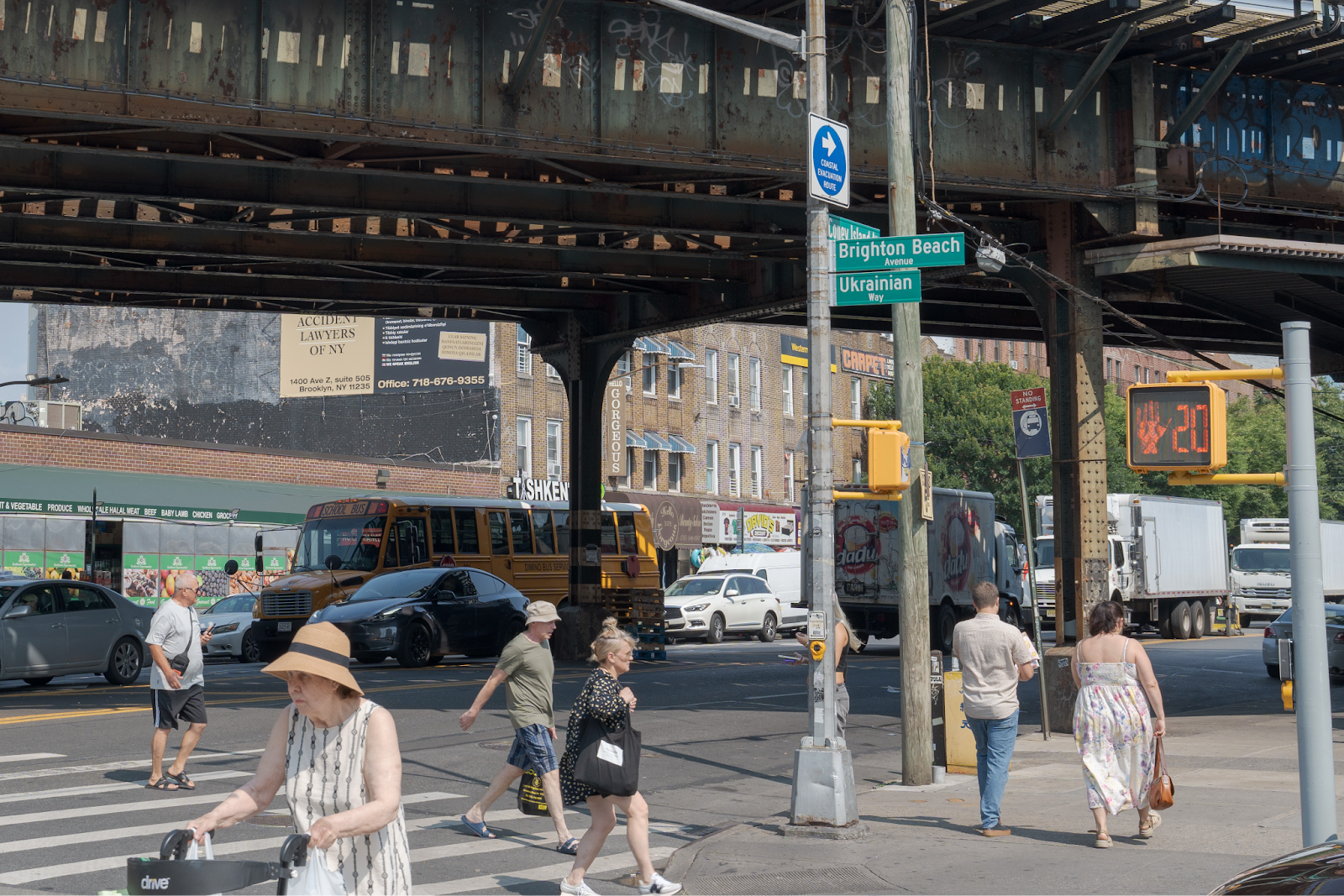
The intersection of Brighton Beach Avenue and Coney Island Avenue was co-named “Ukrainian Way” in 2022 to show solidarity with Ukrainians affected by the war. (Source: Yuri Fujita)
In Brighton Beach, the largest post-Soviet community in the United States, geopolitics filters down into personal decisions and long waits.
By Yuri Fujita, Oral Historian
“Everything is in God’s hands,” Gavkhar Alimova said, almost to herself. She had arrived from Russia, but she was not Russian. Twice in her life, conflict had unsettled her sense of belonging—first in her hometown in Kyrgyzstan, then later in Russia. What she calls her “not-good-stories” had carried her to the United States.
We met at a small cafe in Brighton Beach, a seaside neighborhood in South Brooklyn. The cafe was preparing to close. A worker vacuumed the floor. Alimova was heading to an evening English class, and we caught the short break between her shift at elder care and her class. Outside, trains kept rumbling overhead. The noise filled the pauses in her story.
She told me she was waiting to learn whether she would finally find a place to call home. “I’m an immigrant,” she said. “But I don’t see progress in my documents. The lawyer said to me, ‘Only wait.’ I tried, and we’ll see what happens.”
Her words on waiting echoed what I’ve heard across this neighborhood in more than two years of interviews. Waiting may often be seen as inactivity, the expectation that something will happen. Waiting here means doing everything possible while knowing how much remains outside one’s control. It is the condition Alimova faces every day.
Brighton Beach is shaped by multiple waves of migration over the decades—Soviet Jews in the 1970s and migrants from across the former Soviet republics after its collapse. The community has stayed connected through the Russian language, as it once did in the places people left behind. After Russia’s full-scale invasion of Ukraine in 2022, it saw yet another wave of resettlement. The New York City Mayor’s Office of Immigrant Affairs estimated that more than 40,000 displaced Ukrainians arrived in the city, many resettling in South Brooklyn, including Brighton Beach.
Ukraine is not the only ex-Soviet state to launch waves of exile. The conflict has shaken up geopolitics across other republics, affecting people far from the frontline.
Alimova’s “not-good-stories” are part of a history the size of an empire, whose collapse spawned legions in limbo. Her first displacement came in 2010, when she was raising her children in her hometown, Osh; her youngest was only five. The ethnic violence tore through the city, rooted in Soviet-era borders that had split communities and strained relations for decades. Human Rights Watch has reported that over 400 people were killed and thousands of homes were destroyed. Those who survived had to seek shelter and wait for the violence to subside.
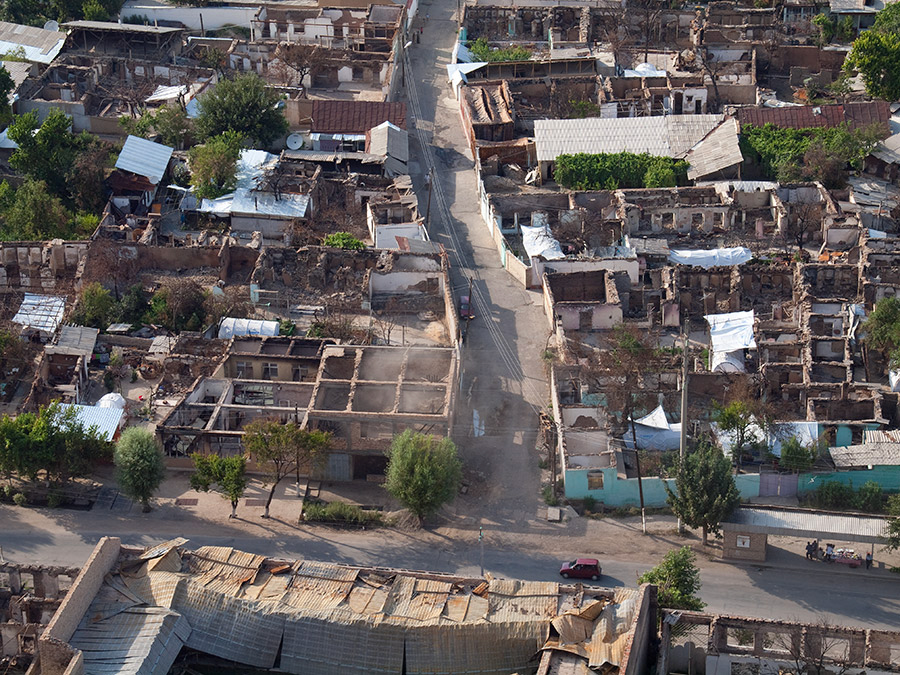
Buildings damaged in Osh during the 2010 conflict. The Kyrgyz government has not acknowledged that ethnic Uzbeks were disproportionately affected. (“Osh after riots 2010,” Evgeni Zotov, licensed under CC BY)
“Everywhere was blood, red and fire,” Alimova said. “I had to hide with my kids in one house. I don’t remember exactly where this place was, somewhere near the river, like in a forest.”
Her voice was steady and firm, but she paused before saying more. Remembering the violence, she said, still makes her feel as if she might lose her mind. At night, she sometimes wakes to make sure her children are still sleeping; once, in the long-ago chaos, she lost track of them entirely. Her father was also caught in the violence. He was detained by law enforcement, and within months, he died from a heart attack, which she believes was caused by torture. “I didn’t want to live in Osh anymore. I had nothing there,” she said.
As hundreds of thousands of people were displaced, fleeing the violence, Alimova moved to Russia with her children. By working multiple jobs as a cashier, she became a Russian citizen in just two years, a faster process for people from former Soviet republics.
She had legal rights but understood she was an outsider. One day in winter, her sons came home bruised, their shirts torn. Classmates had attacked her older son; when his younger brother tried to defend him, he was beaten too. She asked the school for protection, but the violence repeated. When she turned to the education department, an official told her, “Your kids are Muslim. You live in Russia, and you must do everything if you want to live here.”
The same citizenship that gave her stability also made her elder son eligible for military service. In 2022, he received a draft notice from the Russian army. Alimova went to the military commissariat, holding the paper in her hands, and pleaded with officers, telling them her son carried trauma from childhood and could not hold a gun. Nothing changed.
A few months later, another notice arrived: “We need the men.” Alimova could not accept the possibility of her sons fighting in the war in Ukraine. She decided to leave. She departed Russia posing as a family traveling abroad, routing through Dubai and later Mexico. She entered the United States with the documents she had prepared and submitted her case.
She observed my reactions, as if to see whether I understood. She told me that the military draft was only the final trigger. In the years since she left, reports have shown that Central Asian migrants have been disproportionately sent to the front, with high casualties.
Coming to the United States had been her long-time dream, imagining a place where she could belong—where no one would judge them by appearance or religion. Three years have passed since she arrived in New York—three years of longing, three years of waiting. When we first met in Brighton Beach, she carried the gratitude of someone who believed belonging was finally within reach. She didn’t expect the waiting to continue.
The colors, the crowds, the subways—what once dazzled her have gradually become ordinary. In her early months, even the midnight trains felt like a safe and freeing place. “I saw different people—different colors, eyes, and hair. People didn’t care if I was Russian or not. They looked at me as a person,” she said. That feeling has faded. Now, she says, she is scared. “I see people smoking marijuana. They use the subway as if it’s a restroom just in front of me.”
From Alimova—and from others I met in Brighton Beach—I learned that waiting isn’t purely passive. It unfolds through work, parenting, and uncertainty. And its impact grows over time, often altering their choices.
In her closet, Alimova hangs a blue nurse’s uniform. She bought it to hold onto her dream of becoming a nurse—and to show her sons that they can dream beyond what the world has given them. She is taking advanced English classes during the day and works long hours afterward. Sometimes she touches the fabric, reminding herself of the life she is still waiting to step into. She is preparing to apply to a community college program.
“Thank God,” she prays, “I’m going to wear this one day.”