Memory, exile, and the long shadow of dictatorship.
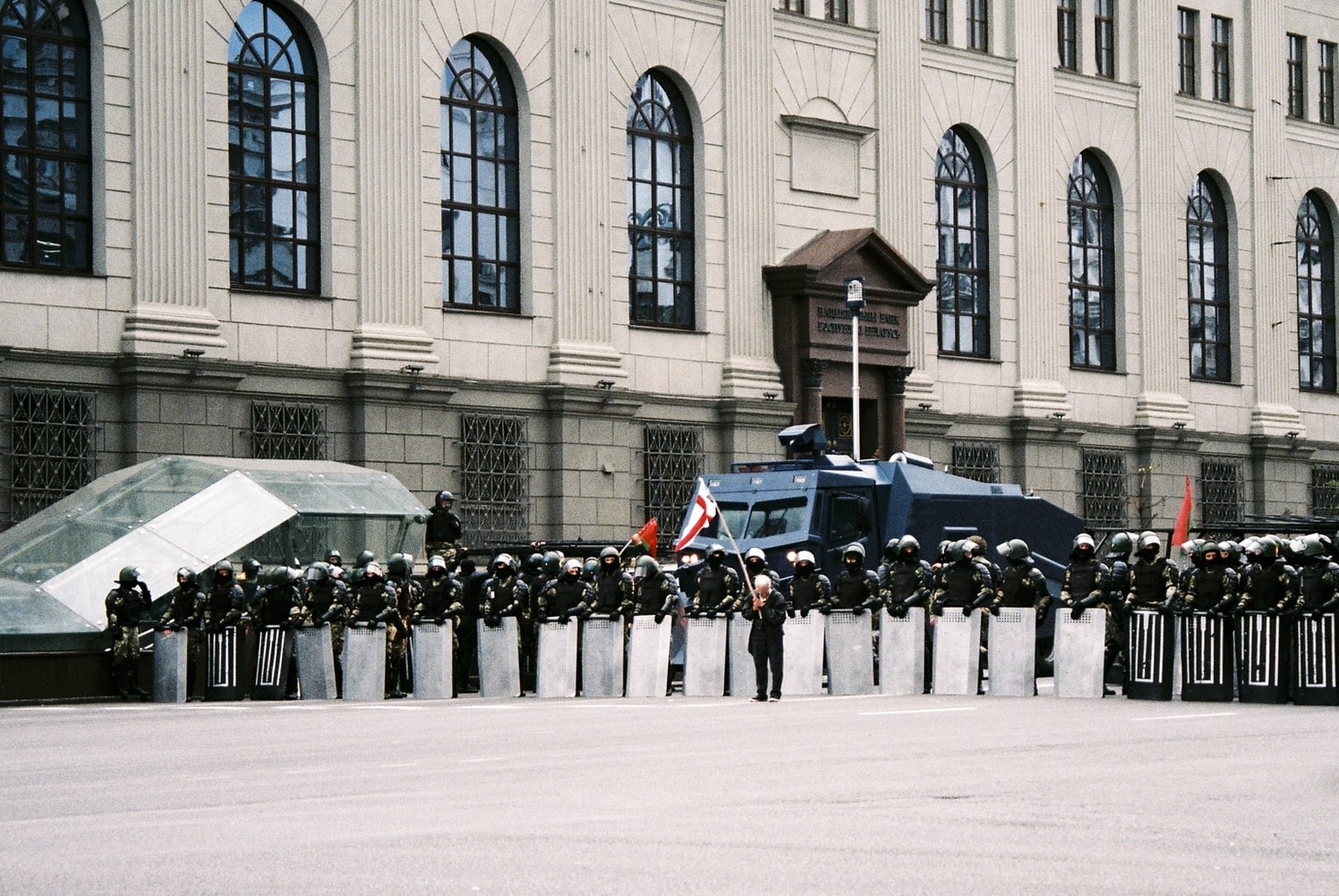
Nina Bahinskaya, a Belarusian human rights activist, holds an opposition flag in front of riot police during 2020 protests in Minsk. Photo: Jana Shnipelson, Flickr.
By Matthew S. Gerson
- Minsk, Belarus
Aleksandr Lukashenko – the former director of a Soviet collective pig farm who has ruled Belarus since 1994 – won a sixth presidential term on August 9, 2020. The election was neither free nor fair, and Lukashenko claimed over eighty percent of the vote while his opponent spent election day in hiding.
One week later, Minsk turned red and white as two hundred thousand protesters draped themselves in the colors of the opposition and filled the city’s Independence Square. Once the site of garish Soviet military parades, the plaza is still adorned with a bronze statue of Vladimir Lenin.
After weeks of protests, Lukashenko ran out of patience on August 30. He dispatched the Belarusian K.G.B. – a Soviet relic that no one had bothered to rename – to lead the crackdown. People carrying flowers and homemade signs were shot, beaten, and hauled away by men in balaclavas. Lukashenko called them “rats” and “trash.” Many were tortured in detention.
Among the crowds was a woman who would flee the country just weeks later. To protect her relatives still living under Lukashenko’s rule, she asked me not to use her name. In what follows, I call her the Exile.
On September 1, university students skipped their first day of class to march through central Minsk. The Exile was there – passing out bottles of water from the trunk of her beige Volkswagen Polo. Police stopped her, wrote down her name, and impounded the car. For the next three weeks, she made daily trips to the station to inquire about her Volkswagen’s whereabouts. Finally, worn down by her persistence, officers handed her the keys.
“Just get away,” a policeman told her.
The Exile followed that advice the next day. After frantically packing a bag and kissing her father goodbye, she piled her belongings into the car and escaped from the country.
At thirty-eight years old, she became an enemy of the state for handing out water.
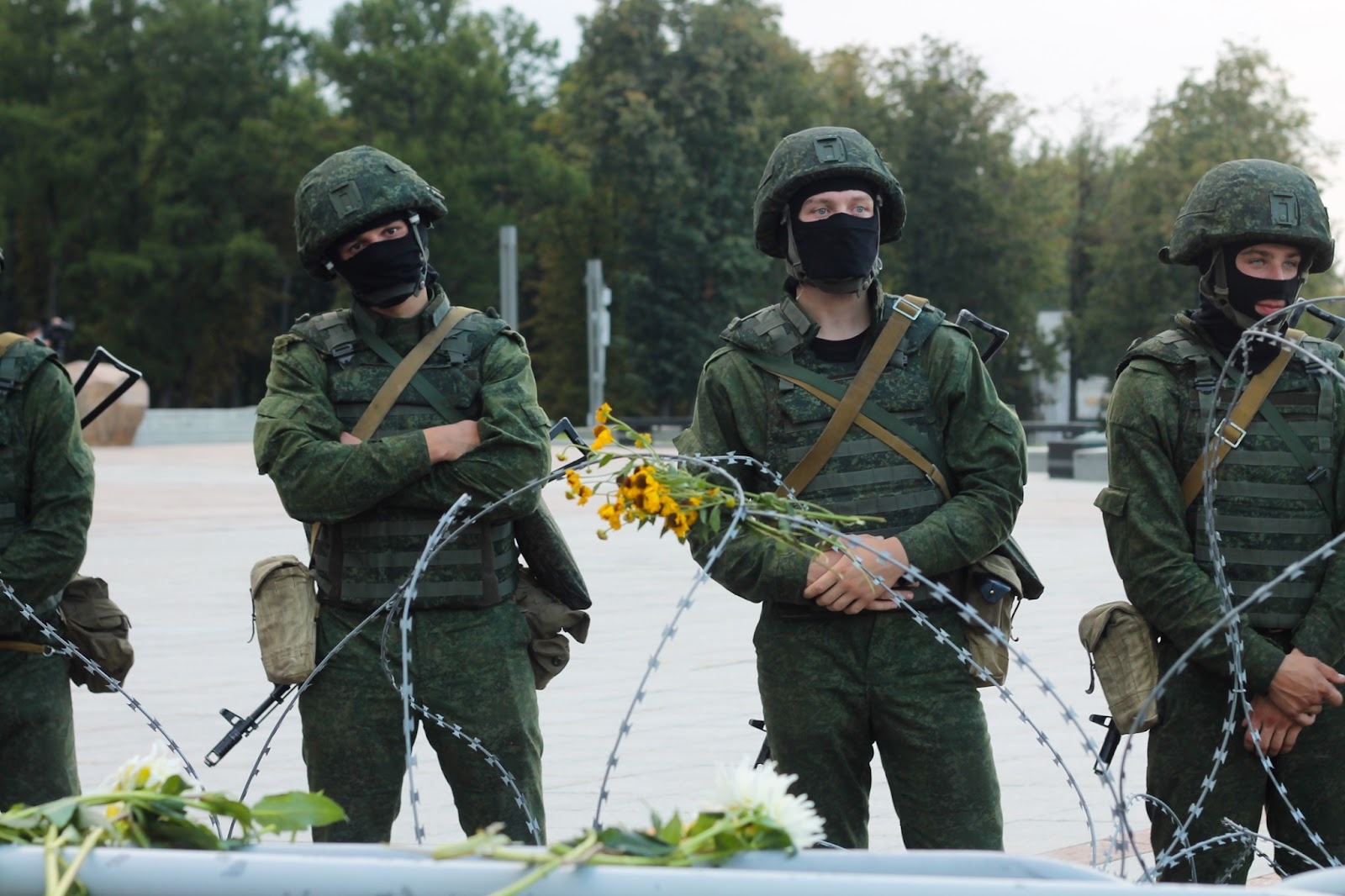
Belarusian security services, missing unit insignia, monitor a protest in central Minsk in August 2020. Photo: Natallia Rak, Flickr.
- Vilnius, Lithuania
The M7 highway snakes northwest from Minsk through primeval forests that once hid Jewish and Soviet partisans during the Second World War. The Lithuanian border is just a two-hour drive away.
At the crossing, border guards questioned the Exile. Where was she going? Why was she leaving now? What did she do for work?
“I was very nervous,” she says, “and probably they found this suspicious.” But when the guards ran her license plate, it came back clean. The car, impounded for weeks, wasn’t in the database. The guards waved her through.
When I met her in Vilnius three years later, she was driving that same Volkswagen. It still had Belarusian plates.
She’s one of three hundred thousand Belarusians who have fled the country since 2020. In her absence, Belarus has spiraled deeper into authoritarianism. Lukashenko disbanded independent media, outlawed civil society organizations, and dispatched opposition leaders to penal colonies.
While Lithuania once welcomed refugees fleeing Lukashenko’s crackdown, political winds shifted after the Russia-Ukraine war. Lukashenko allowed Russian forces to use Belarus as a staging ground for the invasion. Missiles launched from Belarusian soil and Russian troops advanced south from the border toward Kyiv. Russian speakers in Lithuania fell under suspicion, refugees included.
“Nowadays, the attitude towards Belarusians is not very kind,” she says.
One morning at a café in Užupis, the bohemian quarter of Vilnius, I heard a waitress answer the phone in Lithuanian before switching abruptly to English.
“I’m not speaking Russian with you,” she told whoever was trying to make a reservation. New laws required proficiency in Lithuanian for driving tests. Foreign land ownership restrictions soon followed.
By 2023, Lithuanian headlines warned that Belarusians posed threats to national security. That year, the government deported almost one thousand Belarusians deemed security risks. She unsubscribed from popular news channels.
“I don’t want to read about hatred and about how they’re afraid of me,” she says.
But going back to Belarus isn’t an option. Anyone considering doing so will encounter a large, red sign at the Lithuanian side of the border.
Nerizikuok savo saugumu. Nevyk į Baltarusiją. Gali nebesugrįžti.
Do not risk your safety. Do not travel to Belarus. You may fail to return.
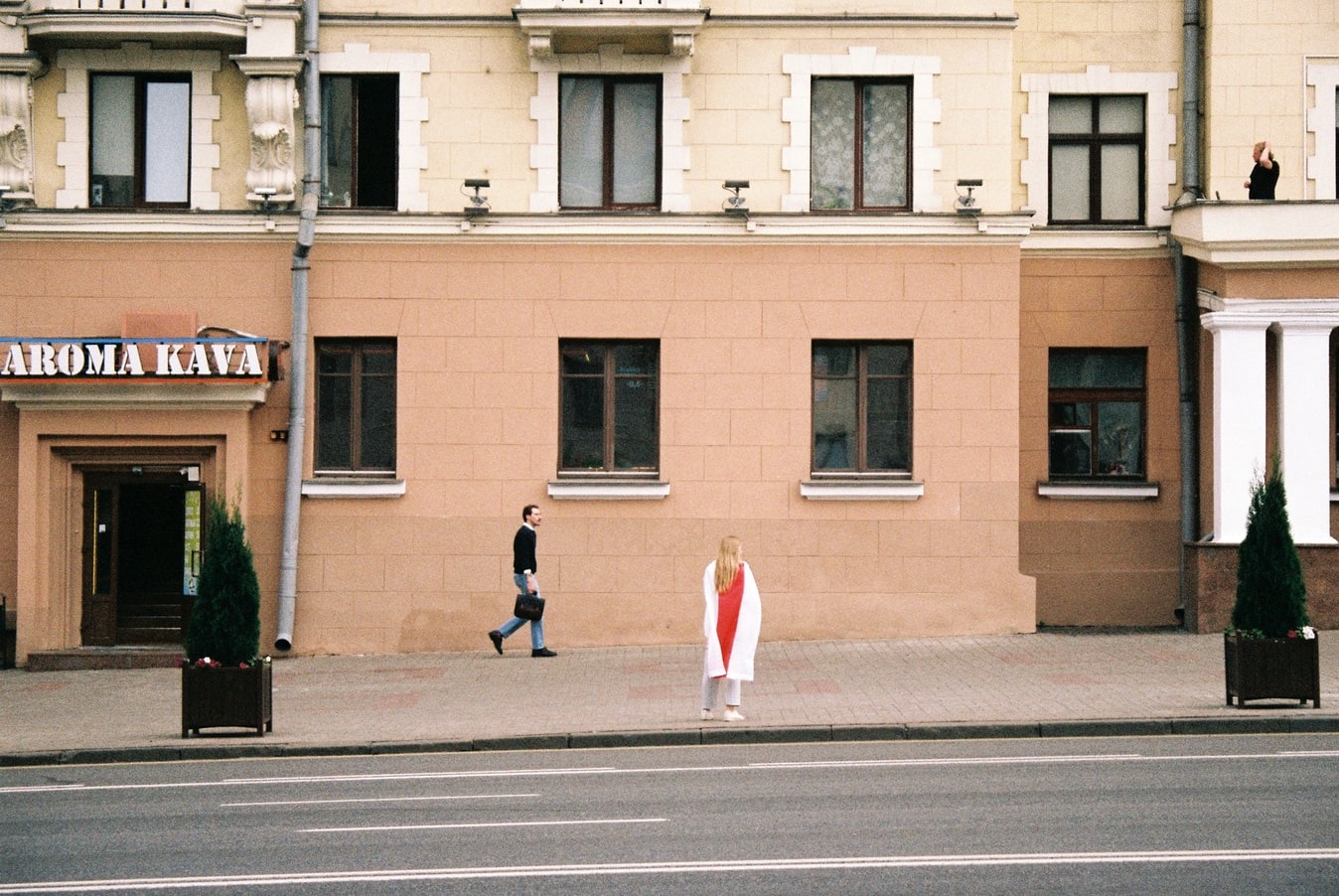
A woman, draped in an opposition flag, stands on Niezaliezhnasci Avenue in Minsk in August 2020. Photo: Jana Shnipelson, Flickr.
- Budapest, Hungary
The Exile last saw her father in June of 2024. They met in Hungary, where Viktor Orbán’s government is friendlier to Belarusians than other European Union states. It took her father a week to get there. He traveled by bus through Poland and Austria before finally arriving in Budapest. For a seventy-five-year-old man, it was a brutal trip. They had three days together.
Her father, a former Soviet military pilot, has what she proudly calls a “clear mind and distrust of the state.” Most of his generation became vata, she explains, using the Russian slang for people who blindly follow state propaganda.
“He’s totally normal,” she says. “He’s totally sane. He’s not poisoned by this.” Nevertheless, they avoided talking about politics for most of the trip.
“We wanted to do regular things that we were so much time deprived of,” the Exile says. So they ate well, walked around the city, and laughed about nothing.
Only on the last night did they speak about the future.
“I’m going to wait,” he told her. “I’m going to wait for you. I’m going to wait for the new country.” The conversation left her heartbroken.
“Seventy-five years for a man from the Soviet Union is not the same from the United States or from Europe,” the Exile says, her voice trailing off. “I just really hope I’m going to see him once again.”
The life expectancy of Belarusian men is sixty-eight.
***
This past August, young people in Vilnius took to the streets to demand the resignation of a new Minister of Culture. The Exile noticed with envy that the Lithuanian protesters encountered no men in balaclavas, no stun grenades, and no mass detentions.
“For them, it’s obvious. And for me, it was a flashback.” She wept as she watched from afar. “They’re so lucky.”