Denim, memory, and a vote cast far from home
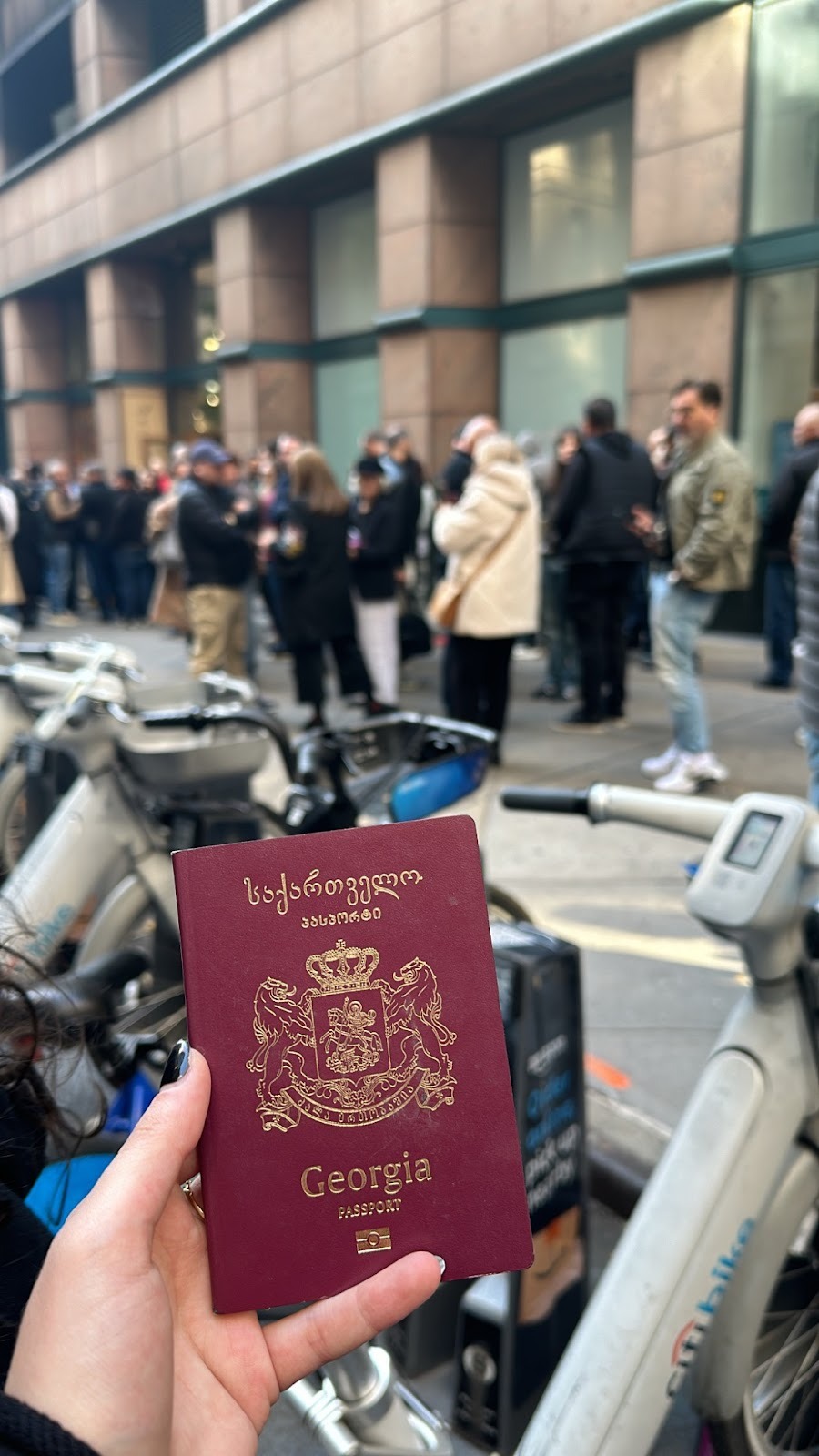
October 26, 2024. Outside of the Georgian Consulate in New York. Source: Author photo.
By Lika Gegenava
I own three pairs of jeans. One is from Levi’s, the second from Paige, and the third from White House Black Market. I wear jeans almost every day. If I do not, it is either too special an occasion or too lazy a day. The latter happens very rarely. If it is just a regular lazy day, I wear my Levi’s.
When I graduated High School, my godfather took me on a tour of Meskheti, a rural region in Georgia. My godfather is a writer, and he tells the story of ancient Georgia the same way he writes about the modern country. I can’t quite recall the whole trip anymore, but I do remember a monastery somewhere up in the mountains. Behind the small church is a field of ruins. “These ruins are from 2000 BC,” my godfather says. “No one knows what they are.”
It is not the ruins that are engraved in my memory but a silhouette of a man leaning against them. An old man, dressed in black and leaning on his staff, greets us as we approach. The monastery is a nunnery, and the nearest village is miles away. “Hello,” he greets us with a melancholic smile, as if there is nothing unusual about his being there. “Hello,” we respond, as we keep walking. When I turn back, he is gone. I attempt to explain the strange encounter, but under the weight of the ruins, my imagination personifies Georgia in him. And in his simple greeting, my mind reads an ancient wistfulness and fortitude collected through time.
Years later, my godfather visits me in New York. He brings me his seminal book. In English, the book is titled Flight from USSR, but in our native tongue, it is The Jeans Generation. “Americans won’t understand the title,” he explains, “They have always had jeans.”
He invites me to his book presentation later that week and asks me to share the book with my college friends. I read it myself instead. I do not like the translation. I wear my Levi’s for days and wonder why Americans should not understand the symbolism. The Soviets did not manufacture denim and had no trading relationship with the West. The Soviet Georgian youth smuggled and wore Western jeans in defiance. The book is a true story, and its characters, in an attempt to flee, died wearing jeans, dreaming of New York in Soviet Georgia.
I didn’t die in my attempt to flee Georgia. Unlike the characters in my godfather’s book, all that was required of me to get on a plane heading for the States was to buy a plane ticket. I walk the streets they imagined in their prison cells. I choose between the various types of jeans available to me, while they wore their single pairs even after the hems tore through. And I wear my Levi’s in New York City as I go to vote in the ninth parliamentary elections of, not Soviet, but independent Georgia.
Ninth Parliamentary Elections
It is an early cold October morning, and a crowd is gathering at the Georgian consulate on East 44th Street. Hours trickle by, but the crowd only grows. By noon, the NYPD blocks the street off. The crowd is unexpectedly large, and they were not warned. Passerbys ask what the line is for. “We are here to vote!” someone answers. Another holds up a red leather-bound passport. The seal glistens as he says, “We are Georgian.”
We wait in line for hours, and I cast my first-ever vote, wearing jeans. As I leave elated, I see the line snakes around the block. They will stay for hours, not leaving until they cast their votes.
The mood shifts overnight. By morning, reports of foul play are spreading across Georgian social media. I am back at the consulate, this time wearing Paige jeans with the red and white Georgian flag wrapped around my shoulders. It is cold, but we stay. “The elections were stolen, and we demand that the consul general come out and speak to us,” a woman on a megaphone says. We wait. The consul general never comes.
Across the ocean, Georgians take to the streets of Tbilisi. They, too, demand accountability, but just like on East 44th Street, those accountable do not come. The police do. I watch through the screen as tear gas capsules explode, I watch as the masked men in unmarked uniforms take batons to the people, I watch as their bloodied bodies are handcuffed and dragged away. I watch as they return the next day, and the cycle repeats.
My godfather returns to New York for another book presentation. This time I go. He speaks of resilience, of how Georgian history has been shaped by the constant fight for independence and freedom. In Tbilisi, Georgians have been out in the streets for almost 300 days. “This is who we are,” my godfather says, “they will not beat us.” He’s wearing jeans too.
After he leaves, I speak to the event organizer: Maka Qobalia, a community leader in New Jersey. She tells me she wants to start a series. More authors come, more conversations are held. Maka organizes campaigns to call American representatives and advocate for Georgia. In Tbilisi, Georgians stand their ground in the street. In New York, we try to use our voice.
Voice Lost and Gained
On day 355, I wake up in my Manhattan apartment on West 84th Street and check the news. I reread the top headline seven times. Georgian citizens can no longer vote from abroad. “If they want to vote, they can return to Georgia every four years and do so,” says the Parliamentary Speaker Shalva Papuashvili. Overnight, our voice becomes conditional. I think of that figure in black at the ruins – briefly there, then gone.
I remember the fights my godfather talked about at his book presentation. It shapes Georgian history, as it will shape mine. I think of the characters in his book again. Would they savor my freedom and slip into the abundance of denim as I do? We won our country back; they would see, we have a voice and the freedom to choose. Only now, our struggle is to defend it. I close the tab on my phone, put on my jeans, and start writing.