A doctor struggles to provide care in a public hospital in Benghazi.
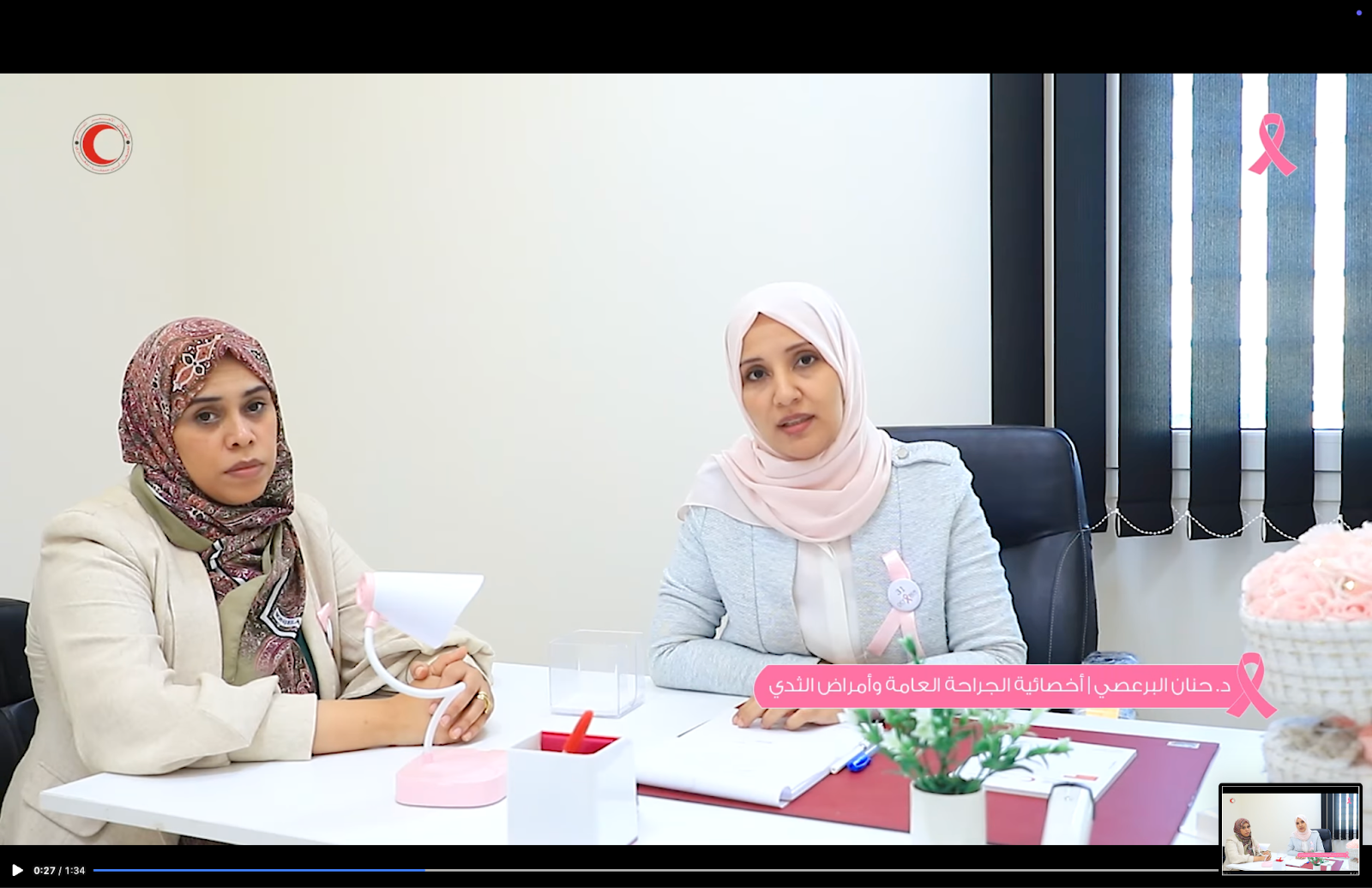
Dr. Hanan Al-Barasi is participating in an awareness campaign for breast cancer under the supervision of Ibn Sina Hospital – Benghazi. 31 Oct 2023. Photo: Ibn Sina Hospital Facebook Page.
Benghazi has been a battleground for years, eroding the city’s already poor health services. Doctors face difficult working conditions from prejudice against women to poor medical facilities and lack of training.
By Fathia Mufti
She is confident, delicate and soft-spoken. Dr Hana Azat Al Brasi a surgeon from Benghazi who graduated from the University of Benghazi with a Bachelor of Medicine and Surgery (MBBCh) degree. She works in many public hospitals like 7th October, Benghazi Medical Center, Al Jalah Hospital and some private ones. She is a dedicated person with big ambition who carries on through a negative high-pressure environment. Indeed, with intense work load, limited infrastructure and training support.
Al Jalah Hospital, with 465 bed capacity, was the exclusive provider of emergency care. It was the only hospital that specialized in accidents and injuries in the eastern and southern regions of the country.1 It was known as a never ending cycle of surgery and accidents. During the 17th Feb Revolution, the United Nations described it “already struggling with resources and suffering from a lack of medical supplies.”2
Three years ago, when Dr Hanan was a second on-call doctor at Al Jalah Hospital, she worked a 24-hour shift in the hospital. At one of those shifts she was doing an appendix operation; the patient was diagnosed as a difficult case. She states, “I am very cautious. I know how and when to take a step. But when I don’t know, I reach out immediately and contact a senior specialist.” That night she contacted the specialist. “In this situation he is supposed to complete the operation and show me the techniques. So in the future when I have a difficult appendix operation, I will have the skills to do it.” However, the specialist conducted the operation without showing her the process. Dr. Hanan said, “He had excluded me, even though his role was to teach and train me.” It is really surprising how lots of female surgeons have been excluded from hospital advanced training.“How can a doctor have this mentality!” she said.
Dr Hanan mentioned another case, for a patient who had a spleen injury from a car accident. His condition was critical. That night she was the supervisor of the surgical team, who are graduates with one and two years of experience. The patient was medically unstable and needed intensive care. At that time, another doctor with the same position as Dr Hanan came and insisted that one of the newly graduated doctors whom he had a connection with should do the operation. Dr Hanan states, “This nepotism in performing medical surgeries without any concerns for patient safety has serious consequences.” These harmful events of negligence and disregard of patients’ lives, besides favouritism against female surgeons, are common in Libyan hospitals. “I strongly objected, but I had no authority over them, so I left the surgery room. Medical lobbies should be prohibited. It is against doctors’ codes.” she regretfully expressed.
Dr Hanan mentioned that Al Jalah has two Laparoscopic Cholecystectomy machines, when one of them failed, all of the operations were done by one medical instrument. That caused a huge delay in the scheduled surgery for the patients. Moreover, for the resource shortages she explained that the most significant ones were the anesthetic drugs, which led to the non-emergency cases being suspended for two or three months. The delay had a huge negative impact on the patient’s medical condition and mental health. She states, “It grieves us as doctors to feel incapable of assisting patients in pain.”
Supporting Libyan doctors with high-standard training and efficient-performing hospitals is an urgent humanitarian need. During the 17th Feb Revolution in 2011, the Battle of Benghazi in 2014 and the pandemic, the medical sector, which had been neglected since the dictator’s era, was totally depleted. Now Libya not only faced the war injuries and the disease outbreak, but also the situation became challenging in providing medicines for cancer or chronic diseases such as diabetes, blood pressure and heart disease.
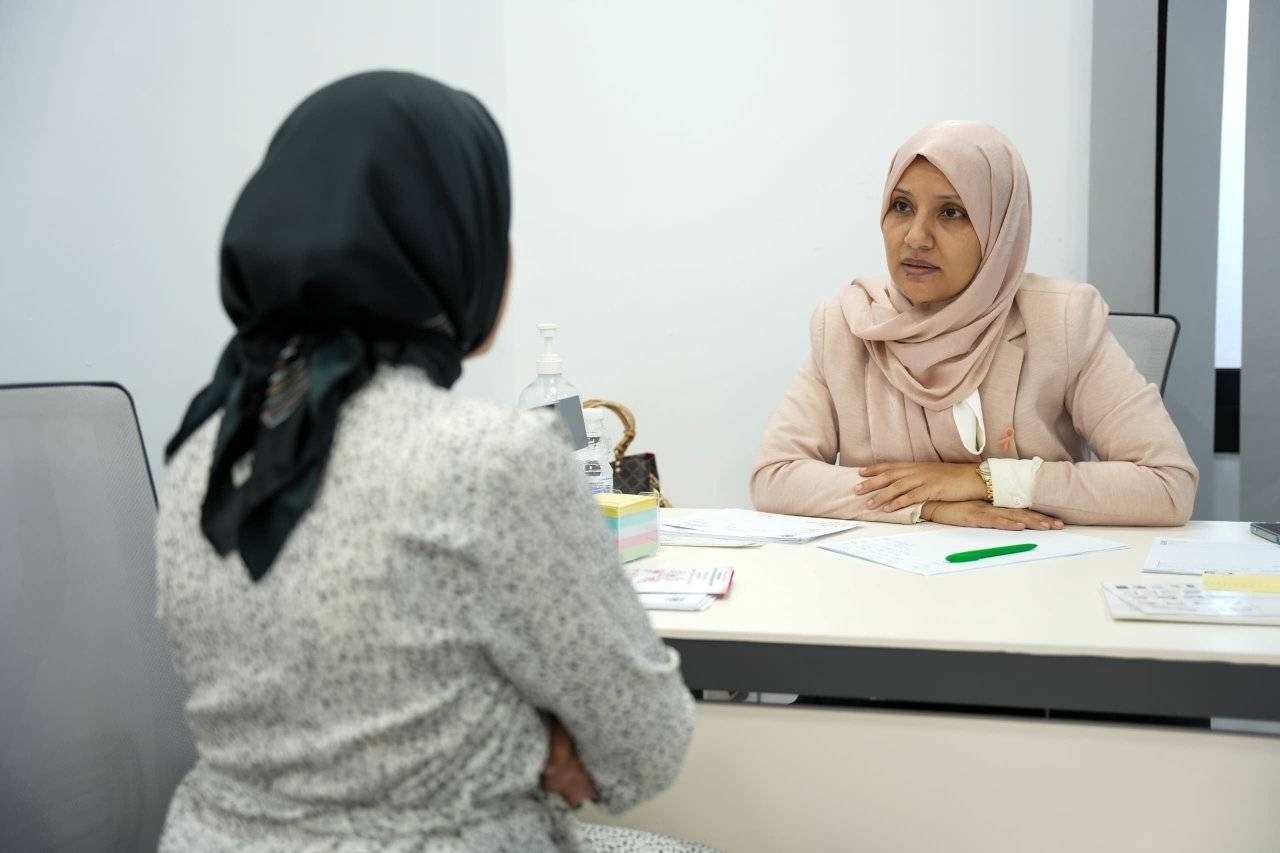
Dr Hanan Al-Barasi from Al-Jalaa Hospital offers free clinical examinations and mammograms. She is part of a specialized medical team that aims to raise awareness about early detection of breast cancer and improve treatment outcomes. October 15, 2025. Photo: from Al-Jalaa Facebook Page.
The first time I met her was as a classmate in 2019 in the only German class in Benghazi. She entered, walking slowly into the room, putting her books and bag in the chair next to her. While fixing her pink scarf, she smiled and said “ Hi .. My name is Hanan Ezat… I am a specialist in General Surgery at Al Jalah Hospital.” I was surprised by how calm she was, given that she worked in one of the most hazardous hospitals in Libya.
In 2019, WHO states, “In Libya, almost 75% of health facilities are closed or only partially functioning due to the ongoing political crisis, and there is a severe shortage of health staff.” 3 The situation of the hospitals faced strain and supply shortage. Healthcare providers were dealing with overloaded, complicated war injuries. These overwhelming conditions have caused services to decline alarmingly on regular care patients for years.
In 2013, He came to the 7th October hospital, a giant man in his mid-forties who was suffering from intense stomach cramps. He was admitted to the internal medicine department and underwent an upper endoscopy, which diagnosed him with high acidity. He was prescribed medication. During his hospitalization days, new doctors like Hanan, who had only graduated one year ago, monitored his condition. He was worsening and failing to recover. He was unable to lie still in his bed due to severe pain. Dr Hanan measured his blood pressure, which was 100/60, and called the attending physician, who did not give him any medication because even painkillers were inefficient. So the attending physician decided to do a CT scan, but the department was closed on the weekend – Friday. The next day when the scan was done, it showed that he had an aortic aneurysm involving thoracic and abdominal parts, which diagnosed a critical medical condition. He needed an emergency operation.
At the 7th October hospital, they could not find a vascular surgeon besides the clinical deficit to perform this operation. At that time, some doctors on duty decided to transfer the patient to Al-Hawari Hospital. The same problem existed again: no specialists to treat such complex cases that day and no equipment available for his critical condition. Then he was transferred to Benghazi Medical Centre, which also refused to admit him. Dr Hanan followed up on the passion by contacting her colleagues at those hospitals, worrying and hoping a solution could be found. After a long day in an ambulance roaming Benghazi’s streets to require immediate surgery, he arrived in a pathetic condition at Al-Jalaa Hospital and passed away that night.
One of the major issues the Libyan medical sector faces is a lack of training in hospitals. Besides, taking medical boards, the licensing exam for physicians, became expensive for most of the students. If they want to do it outside of Libya, the visa restrictions make things complicated. Dr Hanan is also a teaching member in Benghazi University, Faculty of Medicine. She spoke about the government stopping its support of specialising programs outside the country. Before the doctors had a financial support program to do residency and additional years of training abroad to become a specialist. These programs expand physicians’ understanding of global health care system.
Support for studying abroad has halted, and Libyan Board exams are administered without structured training. The examining doctors are trying to “build their knowledge autonomously by finding practice for medical professionals through personal connections.” During this process, Dr Ezat explains, “I experienced a lot of gender discrimination. There are no reliable authorities to whom complaints can be made.” Sadly, female surgeons are constantly exposed to difficult working conditions in an environment that is not supportive of their abilities. “If you object to what is happening, you will be fought even more… and you will become the trouble maker”.. she states.
Dr Hanan volunteers extensively in many breast cancer campaigns across different Libyan cities. She became aware when her mother got a diagnosis of it. The courage and the strength of her mother always motivate her and build strong connections after her father passed away a few years ago. She articulates her own experience as a daughter and a doctor of whom the passionate and their families suffer a lot. As the article The impact of conflict on cancer care in Libya clarifies “challenges facing cancer care in Libya, including limited access to treatment, inadequate palliative care, and a lack of comprehensive data.” 4
Dr Hanan explains that the problem has multiple dimensions. For instance, patients bear the high costs of treatment because of the absence of a health insurance system. The Taxol, which is one of the treatments, costs 200 Libyan dinars. After the economic crisis and the rise of price of dollars in 2015, it reached 400 dinars. Now, it currently costs 1,100 Libyan dinar. Another issue is that the medication is often unavailable. This disease cannot tolerate waiting and delays in medication. “When patients start taking the medication, it must be available and not run out.” she states. Now the situation has become complex with shortages, high prices, the dollar keeping rising, no liquidity, and the prices for medicines fluctuating in private pharmacies. But a dangerous problem is that the quality of medicines has become questionable.
In the past, imported medicines were monitored and under quality control to meet the Libyan state’s standards. The medicines were brought from German, UK and US companies. Today, the quality of medicines is unreliable. “Unfortunately, there are many cases where the condition relapses after starting the treatment, which did not happen in the past,” said Dr Hanan.
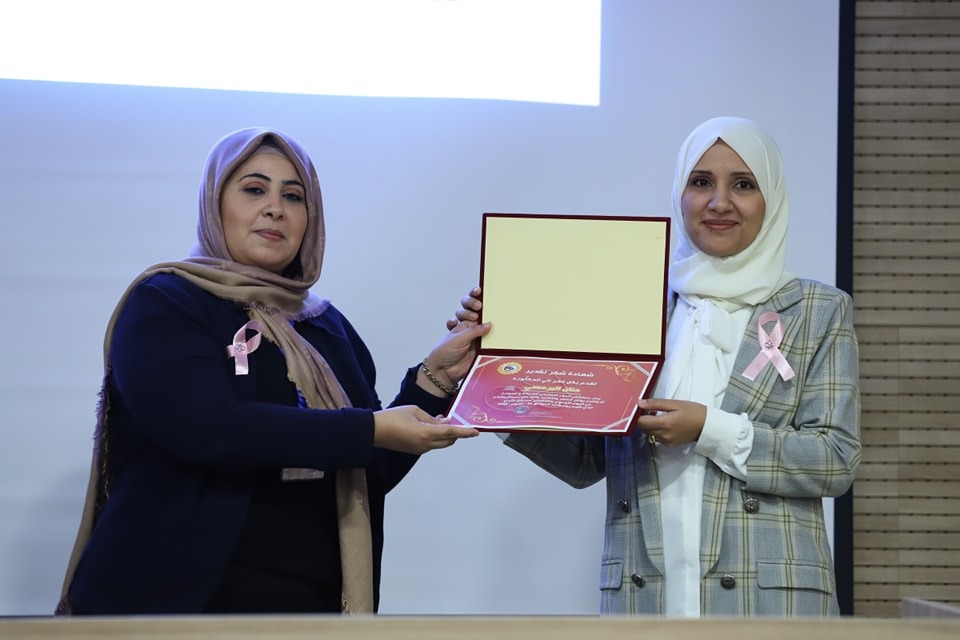
Dr. Hanan was honored after delivering a lecture entitled “Diagnosis and Treatment Methods,” as part of the awareness campaign on early detection of breast cancer. 30 October 2022. Photo: Al-Jalaa Hospital Facebook Page.
Nowadays, Al Jalah Hospital is under renovation. The hospital administration emphasizes that “the aim of the current measures is to improve performance and ensure the continued provision of better quality health services to citizens.” 5
Hanan’s dream is to be among the first Libyan female doctors specializing in Robotic surgery. She hopes the Libyan hospitals’ standards will be raised and clinical training for doctors better supported to reduce the suffering of patients in a country that has been exhausted by a long war.
1 مُستشفى الجلاء للجراحة والحوادث – الرئيسية. (n.d.). https://aljalaahospital.med.ly/arabic/default.aspx
2 ‘Repeated attacks’ could close down key hospitals in eastern Libya, says WHO. (2019b, January 2). UN News. https://news.un.org/en/story/2018/12/1029401
3 The World Health Organization (WHO). (2019, February 5). WHO warns of increasing attacks on health facilities in Libya. https://www.emro.who.int/lby/libya-news/who-warns-of-increasing-attacks-on-health-facilities-in-libya.html
4 El-Mogassabi, A., & Kaziri, I. G. (2024). The impact of conflict on cancer care in Libya. Journal of Cancer Policy, 43, 100528. https://doi.org/10.1016/j.jcpo.2024.100528
المشهد. ( 52025, December 9). مستشفى الجلاء يكشف حقيقة إغلاقه في بنغازي. اخبار ليبيا. https://www.libyaakhbar.com/libya-news/2676736.html