All over the US, millions of veterans such as Hollie Ratajczyk and Joseph Mazzocchi live with the experience of war. It shaped their personality, their choice of life, and ultimately brought them together as a couple.
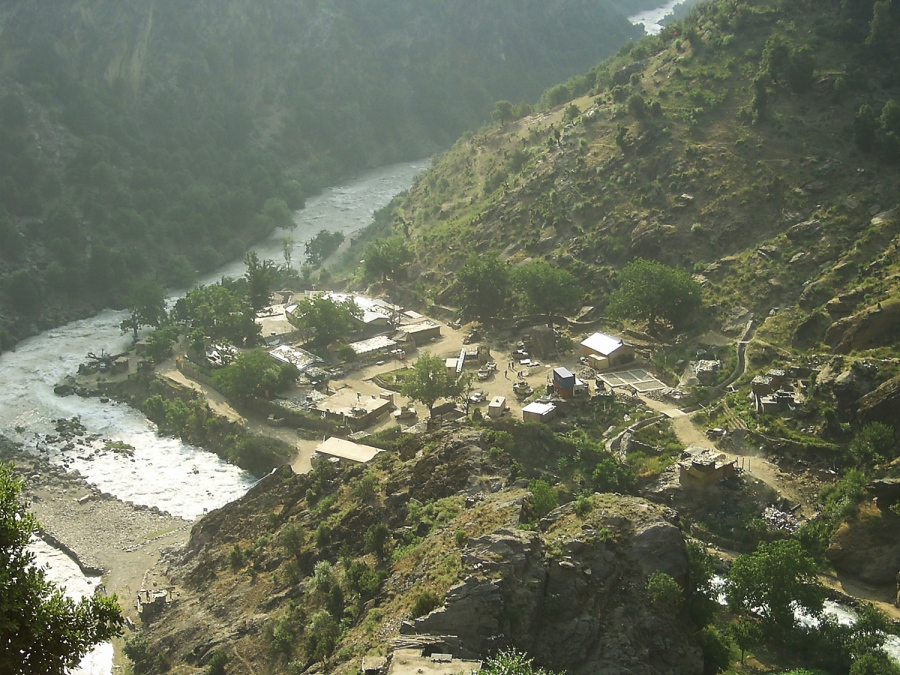
Combat Outpost Keating. (Photo Credit: Brad Larson / Stars and Stripes / Wikimedia Commons / Public Domain)
By Vincent Pouliot
Camp Keating sits in one of the most remote areas of Nuristan Province, Afghanistan, nestled among a mountainous backdrop that recalls the Dolomites. On a freezing cold winter day, Lt. Joseph Mazzocchi had been on a long patrol along the steep valley walls. In the distance, he saw two Afghans walking.
“There is only one reason why we were here,” said Joe. “That’s to kill somebody.”
He assumed the Afghans were out and about for the same purpose but could not tell. As the sun started to set, the numb patrol headed back down to the camp. Just as they were entering, a blast knocked Joe out. An RPG had hit the bastion wall right above.
“It is the closest I came to dying”, he says, 17 years later.
Around that time, at Camp Phoenix in the Afghan capital Kabul, his future wife, Illinois National Guard Lt. Hollie Ratajczyk was in charge of the Troop Medical Clinic, a task for which her experience working as a respiratory therapist in an emergency response team at a hospital had partially prepared her.
“It’s a completely different stress”, she said, “when it’s strangers versus people that are wearing the same uniform as you with the same patch from the same state.”
It was another busy day when she heard a massive blast from an IED. “It vibrated your chest”, she said, “I thought I was going to die”.
According to the “Cost of War” research at Brown University, two to three million U.S. veterans have served in military operations in Afghanistan, Iraq, and related theaters since 2001. Millions of Americans are now back home but carry the impact of that experience in a war zone.
The winding path to Afghanistan
Joe was 17 on Sept. 11, 2001. From his town, he could not make out New-York’s skyline, but he saw the cloud of dust from the 9/11 attacks.
“My country was attacked,” he said, “and to a young person, that was really all I needed.”
His parents did not support Joe’s plan to enlist, but they wanted him to go to college and expected the war to be over by the time he would graduate from ROTC scholarship.
At the time, Joe was not thinking about any combat duty. He was not comfortable amongst the square jaws and V-taper looks. But he turned out to be very good at snap decision-making and field unit leadership. Without too much thinking, Joe opted for being an armor officer on active duty, and joined the 4th Cavalry Regiment based in Fort Hood, Texas. One year later, in 2008, he was deployed in Afghanistan.
The landing at Camp Keating, the first of his three 12-month assignments in Afghanistan, was incredibly violent. For one year, Joe fought nearly daily and witnessed multiple casualties, including the death of his camp commander and friend Rob Yllescas.
“It was a survival mission to not let the camp get overrun” Joe says. And one day, he left. “It just ended. That part of the war was over”.
Ten years before eventually meeting Joe at the Command and General Staff College, Kansas, in 2018, Hollie was also deployed to Afghanistan. She did not want to go, but when her brigade got deployed in 2008, she had to follow. She immersed herself in work, counting each day.
“I was terrified”, she says with a large smile hiding resurfacing stress. “I wanted to leave Afghanistan alive”.
Once, someone told her she would come back home “eventually”. It terrified her even more. Hollie took the first spot to go on a leave, and recalls it was a bad move: “I didn’t have them when I was really burned out”.
The Sun Also Rises
In 2014, after eight years of army service, Joe enjoyed his first non-operational assignment, at Columbia University, studying philosophy.
“It is when I completely crashed”, he says. “I call it The Sun Also Rises years.” “I was angry at all the people who didn’t have any connection to the war.”
So far, Joe had not had the time to think about his service. He was now realizing that while he was risking his life, people his age were enjoying a different world. During this period, his father died. With his war buddies, New-York became a city of every excess.
“I was literally killing myself”, Joe says.
The US Army offers post deployment behavioral help. Later, Joe would benefit from services such as neuropsychological assessment and behavioral health. Was it because he was a senior major working at the Pentagon? In his opinion, such access was way more difficult for younger officers, let alone enlisted soldiers.
Joe found back his balance while studying Greek philosophy at Columbia, and then teaching ethics at West Point. Mentoring young cadets gave him the ability to listen.
“I was very proud of the man that I had become,” says Joe describing what he considers a big issue between army veterans: “trauma compete.” Who had the worst appointment, who had the worst experience?
Joe and Hollie had very different experiences. He never went to Kabul, and she never engaged in combat. Nevertheless, they both knew what it is to go to war, “the experience of loss and suffering and failure” as Joe puts it. They both had seen what it is to make the decision to hurt someone. They never met in Afghanistan, but their parallel experiences in the same combat zone solidified their connection a decade later.
Recalling the time leading to their wedding in 2021, Joe says: “there’s so much explaining that didn’t need to happen. We can get right to the stuff that really matters.”
Both are now retired from the military. Joe is a Program Management Officer at the UN Department of Operational Support. Hollie is building an NGO to help families pay their energy bills. In their daily life, there was a time Joe and Hollie would not bring up at all their military experience. Now, it comes up casually in conversations, as something they did as a professional occupation.
For Joe, Americans have a weird response to veterans. Some are just scared. Some are uncomfortably over-reverent. Others are looking for dirty stories. As a result, Joe and Hollie compartmentalize their military experience from most people they meet. They keep it for their close friends and those who share this experience.
Joe has reprocessed a million times what had happened the day he nearly died from an RPG in Camp Keating. He could have killed these two guys, but he would have had to live with it for 20 years. Instead, he passed his way. They turned out to be insurgents, but they did not manage to even injure him.
Both had missed the target and in a way, it was probably the best possible outcome that day.