Missing in Egypt’s Latest Revolution: The People
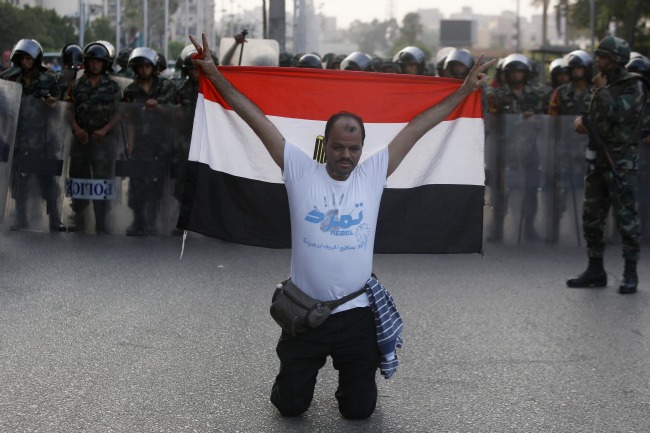
A member of the Tamarod petition drive against Morsi gestures with an Egyptian flag in front of army soldiers in Cairo on July 3, 2013. (Amr Dalsh/Reuters)
[Originally published in The Atlantic.]
Egypt’s struggle today features two flawed and irreconcilable elitist groups, neither of which speak for the popular revolution that upended the status quo. So long as organized Islamists are competing with the resilient deep state, the contest for Egypt will continue to push the country in a reactionary and divisive direction.
Meanwhile, the popular revolutionary forces that seek a reinvented covenant between citizens and their government will continue to play a critical role as a check on tyranny. So long as revolutionaries are excluded from the drafting table of Egypt’s new constitutional order, the country will remain unstable and autocratic. Only when revolutionaries and sincere reformists are represented in a new constitution and a new government will Egypt begin its transition away from authoritarian rule.
The institutional power struggle between Islamists and the Military complex leaves out the most important development in Egypt over the last decade: people power, with an articulated philosophy embodied by the slogan “bread, freedom, social justice.” Until now, the country’s prolific revolutionary impulse remains hostage to the factions competing for the machinery and spoils of government.
***
Today in Egypt, on one side stand the Islamists, who can plausibly claim to represent a popular majority and who possess an articulated project to Islamicize the state, but whose style and substance runs roughshod over the rights and aspirations of many Egyptians, including Christians, women and those of a secular bent. The Islamists have the only organized popular movements with cohesive leadership and cadres.
On the other side stand the forces of the old order, whose byword is stability. It boasts undeniable resources: the army, the police, most of the state bureaucracy including the judiciary, the financiers of the deposed regime, and a powerful elite that benefited from President Hosni Mubarak’s rule and is loathe to erode their privileges. This coalition pays lip service to freedom for minorities and secularists, but has little interest authentic liberalism and liberty.
The ultimate arbiter for all factions remains the military.
Both lay claims to represent the majority, although the Islamists have the edge in the results of the rounds of elections since the Tahrir uprising. Neither of these poles speaks for genuine liberals, revolutionaries, or the idealistic youth movements who provided the heart, if not all the manpower, of the January 25, 2011 uprising. The long-term fight is between adherents of majoritarian revolution and revolutionary pluralism, a distinction made by the scholar Ellis Goldberg.)
Right now we’re caught up in a momentary conflict between the military complex and its reactionary supporters on one side and the Muslim Brotherhood and some religious extremists on the other, leaving out a major and perhaps decisive swath of the population that supports neither.
In this unenviable contest, the likely outcome is an illiberal, authoritarian government that will lay no claim to consensus, and which will be viewed as anathema, even treacherous, by nearly half the population. If the deep state prevails, it will never have the loyalty of the population. If the Islamists prevail, they will never control the security apparatus and the institutions of state.
The original Tamarod movement is not party to this conflict, but is still on stage, at times driving events. They are the constituency for pluralism, due process, political consensus-making, and accountable, transparent, civilian authority.
***
The deposed Muslim Brothers have been making an opportunistic appeal to the most superficial elements of the democratic process: elections and elections alone. Their arguments eerily echo those of Mubarak’s regime before it toppled. “There are a million people in Tahrir Square against Mubarak, but there are 79 million at home who support the regime,” a deluded police officer told me just before Mubarak resigned. President Mohamed Morsi lost his mandate to rule because of the unforced errors he committed in office, which alienated almost every constituency in the country.
Equally opportunistic are the military and police, which perhaps out of different institutional imperatives, have piggybacked on the outraged masses of June 30. Sure, there is a distasteful faction that applauds military rule and which is comfortable with the return of a corrupt, abusive police force that has not faced a single consequence for decades of corruption, criminality, and oppression. But we can’t forget that the millions who signed the Tamarod petition and demonstrated on June 30 and July 2 were demanding Morsi’s ouster; they weren’t demanding a military coup, or a return to Mubarak’s system.
Now, we’ll never know what would have happened had the Muslim Brotherhood government been allowed to confront, dismiss, or negotiate with people power. We’ll never know what the Islamists would have done had they continued to push their agenda and fail politically. We’ll never know how Egyptian politicians and civilians would have responded to the latest showdown absent military intervention. In some ways, the coup has absolved the Brotherhood of some of its share of the blame.
The Islamist threat is real — and so are the dangers of military rule. The most dangerous blow comes from the absence of political evolution. Why is it natural for Islamists to threaten jihad and generalized violence in the face of a coup? Why is it natural for liberals to turn to an abusive, totalitarian, corrupt, and inept military for protection? Both are suicidal moves.
For all the fears of Islamist totalitarian rule, the Brotherhood could never control Egypt; in a year in power, it made scarcely any inroads within the military and police.
Incredibly, some Brotherhood supporters now claim they’re justified in resorting to violence since the system failed them, as if the millions of other Egyptians whose aspirations were stymied by the security state over the years should have been building bombs instead of movements.
Yet the nasty outcome — military coup and Islamist resistance — doesn’t erase the vast and thirsty popular current, which is sizable and real. Its core has been the reformists and revolutionaries, but at different junctures it found allies among Islamists, former regime supporters, and the mostly apathetic citizens known in Egypt as the “Sofa Party.” This popular current felled Mubarak. It pushed the military junta from power in 2012, long before it intended to pass authority to an elected civilian. And now it has ousted Morsi.
It’s a critical problem that the revolutionary fervor has not found its expression in a coherent political movement that can agitate for a tangible system of checks and balances, rule of law, minority rights, economic reforms, and government policies. It is not yet, however, a fatal flaw, nor a weaknesses that justifies dismissing Egyptian people power.
Egypt can survive many more waves of revolt, election and coup, and it will, until the political order begins to reflect more of the will of the people. The latest roadmap repeats most of the mistakes of 2011 (for detailed explanations of how, readNathan Brown and Zaid Al-Ali). The Egyptian public has developed a profound intolerance for arbitrary authoritarian rule; for opaque, paranoid leaders; for governments that ignore the country’s collapsing economy and standard of living.
Revolutionaries might not represent the majority, but they are now a maturing, key constituency. They are unlikely to embrace fascism or fiats from anyone: not the military, not the Brotherhood, not the old political parties. That’s the underlying signal of Egypt’s latest revolt. Until Egypt’s power brokers recognize the core demands of the public and begin to address them, the public isn’t likely to go away.
Egypt & Syria on For Your Ears Only
David Alpern’s show this weekend wonders what on earth Morsi is thinking, and what really happened with Israel’s airstrikes on Syria. Listen to our conversation here.
Not an Ally, Not an Enemy
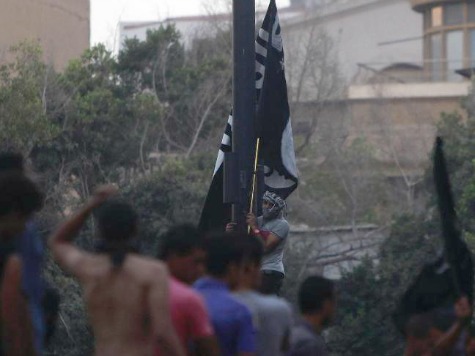
President Obama struck a powerful chord last night when asked about Egypt’s tepid response to the incursion on the American Embassy in Cairo. “I don’t think that we would consider them an ally, but we don’t consider them an enemy,” Obama told Telemundo. The American president’s pointed observation balanced the need to put Egypt on notice against the importance, in diplomacy, of not sounding like a scold.
In this case, Egypt’s president Mohamed Morsi has behaved like a recalcitrant populist, trying to benefit domestically from anger over a private American film that insulted Islam, while not losing any of America’s vital support for Egypt. Perhaps Morsi has read recent Egyptian history and concluded that Cairo’s support is so important that Washington will bear any humiliation in order to retain the special military and security relationship. Yet all international relations have their limits; and Morsi might have forgotten that America accepted a great amount of bad behavior by the SCAF during the 18-month transitional period that followed Mubarak’s fall — but now we’re dealing with an elected sovereign government with a popular mandate and popular accountability. This is the real thing, a democratically governed Egypt. Its president is now responsible for his behavior and for his country’s policy.
In a chat yesterday on Capital New York, I said that Obama would need to pointedly express America’s anger toward Egypt.
Don’t get me wrong: he needs to “engage” the Brotherhood, which means, “have relations” with it. In this case, the engagement should consist of a cold, angry, demand: that they immediately condemn the invasion of the embassy grounds, and that they act responsibly to cool anti-American sentiment—if they expect our financial aid, our military aid, and our indispensable support in getting the IMF and other international assistance vital to Egypt’s economic survival. … I think it will hurt Obama if he doesn’t criticize Egypt aggressively, and in public. And I think the damage could grow if people connect these breaches to America’s broader directionless in the wake of the Arab uprisings.
That’s the real problem, by the way—not the stuff Romney is bringing up.
Obama might finally be making some progress, a year and a half late, in coining a coherent response to the Arab uprisings. His comments about Egypt suggest that Washington is mature and wise enough to begin navigating that gray area between subservient client state and outright enemy; most of the post-uprising Arab world will fall somewhere in that confusing terrain that houses most sovereign states, neither “with us” nor “against us.”
America is contemplating an Egypt that won’t march in lockstep with all its interests. Egypt doesn’t want to go to war with Israel for its own reasons, but it’s likely to be much more hostile and less cooperative there. Same on defense and counter-terrorism. Cairo and Washington will have to negotiate their limited shared interests. The flip side, however, might not yet have dawned on Egypt’s new leaders; America is under no obligation to underwrite Egypt’s military and to a lesser degree is economy with no-strings-attached billions. An independent Egyptian government (or depending on your perspective, an irritating one) will surely be a boon to Egypt’s sense of honor, pride, and autonomy. But it won’t come without consequences. Angering an American government, even a patient one, still carries costs.
Morsi: Dictator, Rebalancer, or Both?
A very interesting conversation on Warren Olney’s To the Point over the implications of Morsi trying to take control. On the one hand, he actually has a mandate, public support, and a known ideology. On the other hand, the Muslim Brotherhood and now Morsi, during the transition, have time and again made self-serving power grabs and exhibited a propensity for authoritarianism. Listen here for a sometimes sharp debate involving me, Marc Lynch, Ehud Yaari, and Kareem Fahim.
Inside the Three-Way Race for Egypt’s Presidency
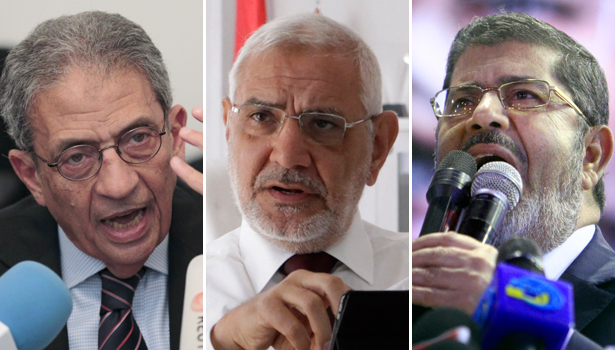
Leading Egyptian presidential candidates Amr Moussa, Abdel Moneim Aboul Fotouh, and Mohamed Morsi. / Reuters, AP
[Originally published in The Atlantic.]
CAIRO — Egypt’s first real presidential contest ever, for which the candidates met last night for the Arab world’s first-ever real presidential debate, has all the makings of a genuinely interesting fight. The front-runners nicely capture a wide stretch of the spectrum, while leaving out the extremes. Voter interest appears high, and the military rulers seem unlikely to allow major fraud based on their record with parliamentary elections.
But enthusiasm about the debate should not obscure the unsatisfying circumstances of the presidential election, which itself does not guarantee a full transition to civilian rule or democracy.
The president’s powers still have not been delineated, and the significance of the race and its victor could be heavily tarnished by future decisions about the assembly that will write the next constitution, among other unresolved questions about whether Egypt will have a presidential, parliamentary, or hybrid system.
Islamists have proven themselves to be the dominant political bloc, garnering more than two-thirds of the vote in parliamentary elections earlier this year. The winner of the presidential race, even if he is secular, will owe his victory to Islamist voters, and will have to govern in tandem with a parliament that has a veto-proof Islamist majority. Islamist politics are malleable and by no means monolithic, but they will drive the political agenda after decades of total exclusion.
The Supreme Council of the Armed Forces, or SCAF, has heavily manipulated the process, deepening its unaccountable and authoritarian mechanisms of control. Crony-packed courts and the presidential election commission have made a series of arbitrary decisions. Egypt’s next government will have to negotiate artfully to wrest the most important powers out of the hands of generals.
The campaign has galvanized Egyptians. This week, the candidates crisscrossed the countryside in bus caravans, and thousands turned out in even the minutest villages.
“He has a special charisma,” gushed an English teacher named Ahmed Abdel Lahib, during a pit stop by the Amr Moussa campaign in a Nile Delta hamlet called Mit Fares. “Egypt needs a man like him,” he said of the former Arab League secretary-general.
Hundreds of men thronged the candidate, shouting, “Purify the country!” and “We want to kiss you!” In his tailored suit, and carrying the patrician demeanor he honed over decades as Egypt’s foreign minister and then Arab League chief, Musa clambered onto a makeshift stage for his short stump speech (fix agriculture, the economy, and health care, long live Egypt!). Men pushed over chairs and slammed one another into the walls of the narrow alley to get closer to Moussa and touch his sleeve.
The oaths of loyalty felt a tad staged and excessive, but similar displays characterized all the major candidate rallies, and could reflect the old authoritarian rallies, or a desire for a galvanizing leader like Gamal Abdel Nasser, the nationalist colonel who took power in a 1952 coup, or simply the enthusiasm of voters who for the first time in their lives will likely get to choose their president.
Moussa has presented himself as a secular elder statesman who can stand against what he portrays as a power-hungry Islamist tide, personified by the other two front-runners: the Muslim Brotherhood’s Mohamed Morsi and the ex-Muslim Brother Abdel Moneim Aboul Fotouh. It is Aboul Fotouh who most worries Moussa’s strategists: he is giving the former minister a run for first place, marketing himself as potential bridge candidate, a “liberal Islamist” who can appeal to Islamists as well as the secular nationalists and revolutionaries who are wary of Moussa’s connections to the old regime.
Thousands of fans in the market town of Senbelawain waited hours on a recent night for Aboul Fotouh, who seems perpetually delayed by traffic (he was late for the historic presidential debate for the same reason). When he arrived, the retired doctor was greeted like a rock star with swoons and chants. Bearded Salafis and women in full-face-covering niqabs jostled with clean-shaven students.
Aboul Fotouh is a more gripping orator than Moussa, with a gruff, gravelly voice that he controls well, shifting cadence to maintain his audience’s attention. “If this country succeeds, the whole Islamic world succeeds,” Aboul Fotouh shouted, provoking cries of exultation. He talked extensively about sharia, in a way apparently calculated to burnish his Islamist credentials while reassuring his left flank that he opposes such literal interpretations as severing the hands of thieves. Aboul Fotouh’s stump speech played to his Islamist base rather than to his revolutionary and secular sympathizers.
A Muslim Brotherhood member in the audience named Yousef Eid Hamid, 38, said he was campaigning for Aboul Fotouh in defiance of his organization’s strict orders to vote for Morsi. “We are not machines,” he said. “You cannot love a candidate, and then just change.”
Backroom deals with the military will likely be decisive in determining how the winner can govern, but retail politics seem to be taking root for now. During Thursday night’s debate, the two front-runners, Moussa and Aboul Fotouh, dug at each other’s records. Aboul Fotouh portrayed Moussa as a corrupt, weak stooge for Mubarak who will continue the old regime’s authoritarian ways. Moussa attacked Aboul Fotouh as a fire-and-brimstone Islamist who founded a radical group in the 1970s and now disingenuously presents himself as a moderate.
Egyptians crammed cafes to watch. During a half-time walkthrough (the debate lasted more than four hours, from 9:30 p.m. to 2 a.m.) at the Boursa pedestrian arcade behind the Cairo stock exchange, I met several people who had voted for the Muslim Brotherhood for parliament but were leaning toward the anti-Islamist Moussa for president.
“I will give the Muslim Brotherhood domestic policy, but I want to keep them far away from security and foreign policy,” said Abdelrahim Abdullah Abdelrahim, 44, an import-export businessman built like a bouncer. “These Islamists want to march on Al Quds” — Jerusalem — “and wage war. It’s not the time for this.”
He went on to mock the Salafi legislator who tried to sound the call to prayer in parliament, and his Noor Party colleague who tried to claim his nose job bandage was really the scar from a politically motivated assault. “People are more tired than before,” Abdelrahim said as he lost another round of dominoes to a friend.
At the presidential rallies in the Delta, I met numerous voters who were shopping or just checking out the opposition. Leftist revolutionaries, committed to minor candidates guaranteed not to reach the second round, listened to stump speeches to consider whom they’d be willing to hold their noses and vote for in a runoff. Confirmed skeptics came, in case they might change their minds.
Arguments broke out. At the end of one Moussa pit stop in Dikirnis, an older man dismissed the candidate as a “felool,” or remnant of the old regime. Another man pushed him hard in the abdomen: “He is not a felool! Amr Moussa is a great man!” The critic scuttled off to his nephew’s pastry shop, where he continued his invective against Moussa. The nephew, 37-year-old Ahmed Burma, smiled benevolently. “My uncle jumped on the revolutionary bandwagon,” he said. “But I’m supporting Amr Moussa. I run a business with 90 employees. Let’s give this guy a chance to work.”
Still, the polls and predictions are little more than guesswork. Most of the voters live without internet or phones and are beyond the reach of the campaigns’ opinion researchers. Egypt has had only one real election in its modern history: the parliamentary ballot that concluded this January. Twenty-seven million people voted, more than two-thirds of them for Islamist parties.
Even with the Islamist vote split between Aboul Fotouh and the Brotherhood’s Morsi, it’s all but assured that one of them will face Moussa in the runoff June 16 and 17. Morsi might fare better than many analysts seem to think, as the Brotherhood deploys its formidable get-out-the-vote operation, which no other campaign can currently match.
The Islamists in parliament haven’t acquitted themselves well, wasting time on fringe religious debates while the economy sinks, deferring to the army on crucial issues such as military trials for civilians, and alienating almost every major constituency in the country other than their own by trying to impose a constitutional convention packed with Salafist and Brotherhood members.
If turnout is as high as it was for parliament (and it might be higher, since the president has always been the commanding figure in Egypt’s modern political system), Moussa would need to convince more than 6 million people, a full third of those who voted Islamist for parliament, to switch allegiance and vote for him. His advisers believe that’s possible.
They also seem to think that Moussa’s year-long bus tour of rural areas will pay dividends, and that their basic selling point resonates with common voters: a pair of safe, experienced hands for a transition.
Nonetheless, Moussa’s strategy smacks of secular liberal wishful thinking, a common affliction among Egypt’s veteran political class in a year and a half of dynamic change. It might just work out for him, but an equally likely scenario would have the voters that propelled Islamists to parliament eager to give someone with their values more of a chance for success than has been allowed by three months of parliamentary machinations under the shadow of the military.