Confronting the “Moscow Track” for Syria
Issue brief for The Century Foundation. Download PDF.
Russian President Vladimir Putin is scheduled to address the UN General Assembly on September 28, on the heels of a shrewdly publicized deployment of new Russian troops and military equipment to Syria. Simultaneously—and not for the first time—the Kremlin has rolled out the prospect of a “Moscow Track” to peace in Syria, marketed as a pragmatic alternative to the failed U.S.-run Geneva Process.
Moscow’s latest moves have begun to shift the ground, and ultimately the United States will have to choose between two different, equally messy courses: standing aside and letting Russia and Iran shape the conflict unimpeded; or making a real diplomatic and military commitment in the hopes of influencing the Syrian civil war’s final disposition.
Already, a chorus of analysts and political actors is advocating a “hold-your-nose-and-make-a-deal with Russia” approach,1 claiming the United States must either sign on to Moscow’s plans against ISIS, or else plead guilty to promoting terrorism through American inaction.
But framing the choice as a binary one plays into the rhetoric of Bashar al-Assad and his sponsors, and ignores the fact that substantial American action can still reshape the dynamics and alter the outcome, just as surely as decisive Russian, Iranian, and Syrian moves could. The more time passes, however, the fewer options remain for the American camp.
Until President Obama decides to invest in a new Syria policy or else completely relinquish any stake in the conflict in the Levant, there’s little to discuss with Putin. Russia comes to the table with clear aims and a plan to achieve them; the United States needs its own goals and strategy before engaging in a conversation.
The most effective approach for the United States right now would be to quickly commit to a program that supports alternatives to Assad and opposes ISIS—while making clear that America would back peace talks that include all foreign sponsors and all domestic players in the conflict, with the exception of ISIS and other jihadis.2
This brief argues that such an approach is an essential precursor to any “Moscow Track” for Syria, and could well render it obsolete. It lays out where American and Russian interests in Syria overlap and where they diverge, and examines the limits of Russia’s going it alone. Finally, it outlines a course of U.S. action that would expand the options for the Syria crisis beyond the limited and troublesome alternative solutions currently under consideration.
Russia’s Interests—and America’s
Syria is Russia’s most solid foothold in the Arab world, and offers a strategic alliance, military contracts, and a critical naval base in Tartus. So, in the short term, Russia’s ramp-up is only an increase in the degree of Moscow’s long-running commitment to the regime of Bashar al-Assad.3 Many foreign and domestic constituencies are also influencing the course of Syria’s war. Arab monarchies in the Gulf, along with Turkey, have kept alive a Sunni-dominated insurgency that has fought the regime and its backers to a stalemate. The fighting has catastrophically crippled the nation’s institutions and infrastructure.
If the United States does not respond to Russia’s latest move with a concrete shift in policy soon, it will effectively cede the theater to Damascus, and its patrons in Iran and Russia. Eventually, momentum could shift in the regime’s favor. If Russia solidifies its presence in Syria further and installs better air defenses, the United States will no longer be able to easily consider pivotal interventions, such as establishing a no-fly zone.
Not all of Russia’s interests and intentions in Syria conflict with those of the United States, however, and in fact several overlap:
- Moscow and Washington abhor jihadi extremists and are obsessed with protecting their homeland from terrorist attacks.
- Both fear “blowback” from movements they have fought abroad.
- Neither power likes a power vacuum in a strategically sensitive Middle East; despite Washington’s looser rhetoric, both powers are fundamentally conservative about regime change.
- Both want to preserve the institutions of the Syrian state and keep its borders intact at the end of the current civil war. In fact, both powers are invested in the existing Arab state system and do not wish to see the emergence of new states or the redrawing of borders.
But a number of crucial differences separate the two powers:
- While Russia sees Bashar al-Assad as a solid partner, the United States sees him as a long-term strategic threat who cynically allowed jihadis to flourish in Iraq, Syria, and Lebanon, and backed militant groups such as Hezbollah and Hamas.
- Russia supports the Iran-Syria alliance and an arc of anti-American regimes and non-state actors from Tehran to the Mediterranean. For obvious reasons the United States sees that alliance as a threat to its hegemony in the region and to the rough alliance of U.S.-allied Arab states.
- Russia and the United States are at loggerheads elsewhere: over the Ukraine, energy supplies to Europe, and the Iranian nuclear program.
- The two powers exhibit vastly different levels of willingness and capacity to fight ISIS.
- Finally, and perhaps most importantly, Russia has much more narrow and easier to fulfill strategic aims: shore up a local client dictator, preserve a military foothold, and dent jihadist capabilities. The United States on the other hand has a wide range of hard-to-reconcile regional aims; and for all its equivocation, Washington’s aim is to stabilize the region. It does not have the luxury and clarity of a spoiler’s agenda.
What Can Russia Actually Achieve?
Much of Washington’s reaction to Russia’s surge has been devoid of context and long-term perspective. Of course, an injection of Russian fighters and equipment will change the dynamics of the fight; but there is no evidence that Russian intervention will have a conclusive impact. By way of comparison, a considerably larger U.S. occupation force in Iraq was unable to eliminate Al Qaeda in Iraq, the Islamic State’s precursor. And the Soviet Union’s attempt to decisively shore up a local partner against jihadi rebels—in Afghanistan in the 1980s—failed mightily.
Russia and Iran both benefit from an inflated reputation in Syria. Both powers have spent considerable funds and manpower to prop up a regime that has steadily lost ground during four years of war. Betting on the regime has been costly, and Russia’s decision to double down exposes it to still greater risks and costs. It will take time to see whether Russia is engaging in a limited and achievable intervention—striking ISIS while shoring up the regime’s heartland—or a more far-fetched all-out venture to win the war outright for Assad.
Syria’s dynamics are unique, of course, but there is no sound reason to predict Russia can wipe out the anti-Assad rebellion as it now stands. Foreign influence has shaped the Syrian war for years—through the limited impact of previous gambits in Syria by the United States, Iran, and the Arab Gulf monarchies—but has not been able to decide its outcome, underscoring the need for modest Russian expectations.
Russia and Iran together can probably assure that their local partner in Damascus remains in power over some portion of Syria, but it is less clear whether they can re-extend Assad’s ambit beyond the rump state he controls today. It is even less clear what will survive of Syria’s national institutions. And there will surely be blowback. Fighters from Chechnya and other former Soviet republics already are fighting with the Syrian rebels. Their ranks are almost guaranteed to swell now that Russia has publicly upped its ante in Syria.
How Should the United States Respond?
Until now the United States followed a wishy-washy course, typified by the “non-strike event” in the summer of 2013,4 when Washington backed down from its threat to intervene against Assad’s use of chemical weapons.5 Once America abandoned its fixed red lines,6Washington downgraded its already limited leverage over the conflict, while remaining vulnerable to its consequences. Ever since, the major players in Syria have vastly lowered their expectation of any U.S. involvement whatsoever, whether political, economic, or military.
The United States wants Assad gone, but has done little to hasten his fall because the available options to replace him are poor. Washington wants “moderate” rebels, but also does not want to get dragged into a civil war. As a result, it has not given any meaningful support to any militia that has a serious combat presence, and it has not exercised any political or military muscle that would change the balance of power on the ground.
At times, Washington has even appeared to believe that a quagmire in Syria would somehow serve U.S. interests by draining the resources of a gang of bad actors: Iran, Hezbollah, Assad, Russia, the money men in the Arabian peninsula, ISIS, and Al Qaeda.7Counterterrorism officials seemed to believe that the threat from ISIS was local, and could be bottled up in the Levant without any blowback beyond Syria’s borders.
All the assumptions underlying American inaction, however, were blown apart by a series of cataclysmic events: the concurrent implosion of Syria and Iraq in 2014 at the hands of ISIS, followed by the entrenchment of a sustainable jihadist empire headquartered in Mosul, and finally a human wave of displaced people remaking the demographics of Syria’s neighbors and flowing through Europe. No matter how hard the U.S. government has tried to contain, cauterize, or ignore the Syria war, its strategic ramifications continue to demand notice.
Putin’s showmanship has once again created a sense of urgency, just as the refugee crisis, the emergence of ISIS, and the use of chemical weapons did in early periods of the war. In response, some analysts and politicians in the United States have focused on the public relations fallout from Russia outmaneuvering Washington.8 In the case of Syria, that image reflects reality. Russia is achieving its admittedly simpler, Machiavellian goals far more successfully than the United States because Russia is far more committed, has dedicated far greater resources, and has a solid ally in power in Damascus.
If, after all the political calculations are made, the United States is unwilling to shoulder the risks of a heavier involvement in Syria, then it must make a clear case that inaction is a safer, smarter, and more responsible course than intervention. It must argue that any greater military involvement would make the human toll worse. And if it decides to pursue inaction and still wants to maintain some semblance of its role as a humanitarian world leader, the United States must also make a serious production of spending money and resources to contain the wider fallout of the conflict in terms of contagion and refugees. Washington has led international donations to the Syrian refugee response and insists it is a priority, but American contributions have been inadequate to address the crisis. United Nations appeals remain massively underfunded, and millions of refugees live without any secure status in Turkey, Lebanon and Jordan. If the United States decides to limit itself to addressing the humanitarian needs, it must immediately commit to resettling a number of refugees in the six figures, and ought to commit enough money to fully fund the UN’s Syrian refugee appeals.
A better course of action would be to get off the fence and aggressively pursue a plan that promotes an inclusive national solution to the Syrian conflict, one that would address core concerns about governance, corruption, and the disenfranchisement of many Sunnis.
Such a course would be fragile and full of risks, but the alternative is worse: a de facto alliance with Putin, Assad, and Tehran in shaping the future of Syria. In that scenario, the very same parties that drove Syria to collapse and green-lit the unfurling of a massive international jihadi wave would dictate the terms of a counter-jihad, with the United States playing a supporting role. An American junior partnership with Assad and Putin would be bad geopolitics for the United States—and it also would be unlikely to bring peace to Syria.
What would a more effective solution look like? The United States cannot wisely sign onto an anti-ISIS alliance composed solely of Assad, Russia, and Tehran. A genuine anti-ISIS campaign must have support from Syrian Sunnis if it is to have any chance of success. A national coalition backed by all the major non-jihadi players would be the only viable vehicle for fighting ISIS and stabilizing Syria as a whole. It would be a long shot—and it would become a possibility only if the United States decided to provide a significant counterweight to the Damascus-Moscow-Tehran alliance.
That position would entail a serious and major U.S. commitment, including a no-fly zone and safe havens, and partnerships with any non-jihadi militias willing to rhetorically embrace basic values of pluralism and shared governance.
Crucially, this American involvement must be accompanied by a new diplomatic initiative from Washington, inviting all the conflict’s foreign sponsors and all its domestic stakeholders—except for the jihadis—to take part in designing and supporting a transitional government. Assad and his circle would have to be part of that negotiation.
Talking to Putin about Syria will not make America look more ineffectual and disconnected than it already does. On the other hand, there is no reason to start a dialogue unless the White House has something to say. Articulating and putting resources behind a regional strategy to resolve the Syrian problem would be a good opening statement in any conversation with Russia.
Notes
1. Dmitri Trenin, “Like It or Not, America and Russia Need to Cooperate in Syria,” Carnegie Moscow Center, September 17, 2015,http://carnegie.ru/2015/09/17/like-it-or-not-america-and-russia-need-to-cooperate-in-syria/ihuf.
2. Thanassis Cambanis, “A Plan for Syria,” The Century Foundation. July 28, 2015, http://tcf.org/work/foreign_policy/detail/a-plan-for-syria.
3. Borzou Daragahi and Max Seddon, “This Is What’s Behind Russia’s Push Into Syria,” BuzzFeed News. September 16, 2015,http://buzzfeed.com/borzoudaragahi/this-is-whats-behind-russias-push-into-syria?utm_term=.hxEzEKAKj5#.am50r2PlPE.
4. Patrice Taddonio, “‘The President Blinked’: Why Obama Changed Course on the ‘Red Line’ in Syria,” Frontline, May 25, 2015,http://pbs.org/wgbh/pages/frontline/foreign-affairs-defense/obama-at-war/the-president-blinked-why-obama-changed-course-on-the-red-line-in-syria/.
5. Mark Landler and Jonathan Weisman, “Obama Delays Syria Strike to Focus on a Russian Plan,” New York Times, September 10, 2013, http://nytimes.com/2013/09/11/world/middleeast/syrian-chemical-arsenal.html?pagewanted=all&_r=0.
6. Josh Rogin, “Syria Crosses Obama’s New Red Line,” Bloomberg View, March 19, 2015,http://bloombergview.com/articles/2015-03-19/syria-s-chemical-attacks-cross-obama-s-new-red-line.
7. Thanassis Cambanis, “How Do You Say ‘Quagmire’ in Farsi?” Foreign Policy, May 13, 2015,http://foreignpolicy.com/2013/05/13/how-do-you-say-quagmire-in-farsi; and Thanassis Cambanis, “Should America let Syria fight on?” Boston Globe, April 7, 2013, https://www.bostonglobe.com/ideas/2013/04/06/should-america-let-syria-fight/UUtDpctZYyeymgSjgRSBWK/story.html.
8. Jonathan Broder, “Can Putin Save Assad in Syria?” Newsweek, September 16, 2015, http://newsweek.com/russia-syria-isis-putin-obama-assad-372864.
When diplomacy is most needed, America flees
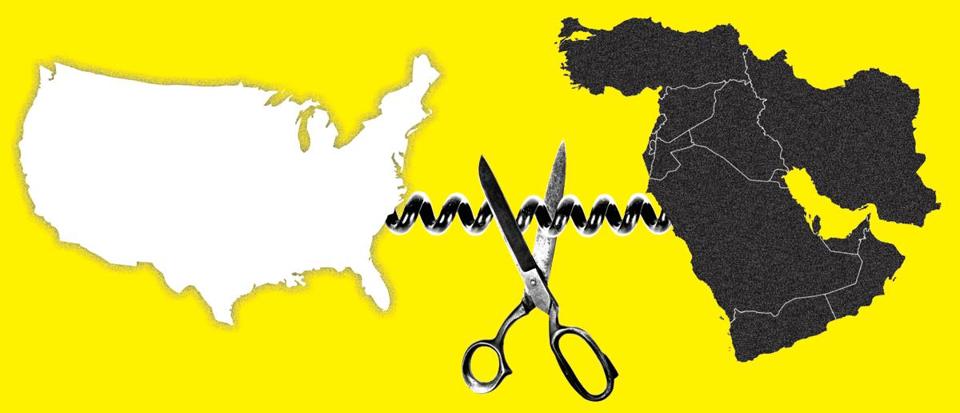
Illustration: KIM MAXWELL VU/GLOBE STAFF
[Published in The Boston Globe Ideas section]
BEIRUT — On the day that Houthi rebels took over the capital of Yemen in February, US diplomats moved into high gear to do what they are increasingly tasked with doing when the countries they cover explode into crisis: Pack up and leave.
In the month that has followed, Yemen has erupted into one of the scariest hot spots in the world, hosting a high-stakes regional war entangling most of America’s allies and enemies on top of one of the busiest shipping lanes for the global oil supply. Additionally, there is the threat of terrorism: Yemen has produced some of the most significant Al Qaeda plots against American targets since 9/11, but counter-terrorism and intelligence-gathering efforts have collapsed along with the US diplomatic exit.
With no diplomats, counter-terrorism operatives, or top-secret spies on the ground, the United States is left with less visibility than ever into a rapidly shifting conflict.
It’s not that foreign service officers suddenly lack the courage or desire to stay put when the countries where they’re stationed go haywire. Rather, a succession of United States administrations has increasingly decided that, in a post-9/11, post-Benghazi era, the stakes for putting civilian diplomats in harm’s way are too high. President Obama’s political wrangle with Congress in the aftermath of the 2012 murder of J. Christopher Stevens, the American ambassador to Libya, made an already deteriorating situation even worse. Few, if any, US diplomats today are given the freedom to exercise their professional judgment of what risks are worth taking.
Throughout the combustible region stretching from Pakistan to Morocco, where America has expended most of its foreign policy energy in the last four decades, its diplomatic presence operates at a paralyzing remove, behind concrete as well as perceptual barriers. And intentionally or not, the result leaves the United States flying blind in places where information is the hardest to obtain and where diplomacy may be the most vital.
“WE ARE NOW too restrictive. We need a course correction,” said Ronald E. Neumann, who served as an American ambassador in volatile spots including Afghanistan and Algeria, before retiring in 2007.
Crafting foreign policy requires information and judgments that even the most skilled diplomats and observers can’t cull from afar, Neumann explained. In Yemen, for instance, with the well-connected ambassador now having to work remotely by phone and in meetings abroad, the United States is forced to rely much more on the biased analysis of allies like Saudi Arabia.
“If you’re going to avoid a civil war, it requires understanding what the parties want and being able to broker solutions,” Neumann said. “You can’t do this from a distance.”
But a great distance is exactly what separates American diplomats from flashpoints like Yemen, Syria, and Libya today. In other war zones like Iraq and Afghanistan, the United States retains an information network from its long periods of military occupation, but that too is shrinking. American understanding and insight into global conflicts are as limited as ever.
What is lost when diplomats must withdraw — or are forced to operate out of fortress embassies with elaborate security protocols restricting their ability to meet with the people who provide crucial analysis and avenues of influence? Can America even properly understand the places that top its list of threats?
THE DANGERS TO Americans serving the country’s interests abroad are very real and long-running.
“If you’re an American, you’ve got a bull’s-eye on you that others don’t,” said Ryan C. Crocker, who has served as ambassador in Afghanistan, Iraq, Pakistan, Syria, Lebanon, and Kuwait.
In 1979, Iranian radicals took over the US Embassy and held 52 hostages for more than a year; that crisis fatally hobbled Jimmy Carter’s presidency. In April 1983, a suicide bomber blew up the US Embassy in Beirut, killing 63. In 1998, massive bombs ravaged the American missions in Kenya and Tanzania. These attacks are only the most scarring of dozens of bombings, assassinations, and other assaults that have targeted US diplomats over the years — so many that the State Department collected them into a glossy brochure.
The consensus among career diplomats is that there’s a way to do an effective job despite threats — so long as they’re allowed to take some risks and keep missions open even in turbulent countries.
But at least two factors have conspired to dramatically reduce America’s diplomatic footprint. The first is the complexity of the threats and violence in trouble areas like Yemen, Libya, and Syria.
The United States shut down its embassy in Damascus in 2012 because of the risk of suicide car bomb attacks. As Libya melted down in the summer of 2014, diplomats were ordered to leave. The same thing happened when the war in Yemen spiraled this February. In three of the four war zones presently raging in the Arab world — all conflicts in which the United States is either directly involved or has close allies fighting for critical interests — the State Department has no eyes on the ground.
“You lose an enormous amount when you’re no longer in the country. You have a reduced ability to persuade and influence, and a reduced ability to understand,” said Robert Ford, who served as the last US ambassador to Syria.
When the uprising began in 2011, Ford was omnipresent, cutting an unusually visible profile for an American diplomat, even paying a surprise visit to antiregime protesters in the city of Hama in July that year. He reluctantly closed the Damascus embassy in early 2012 but continued the job for several years at a distance before retiring and becoming a critic of US policy on Syria from his perch at the Middle East Institute, a Washington think tank.
The second factor hampering diplomats is the political skittishness that followed the murder of Stevens and three other Americans at the hands of extremists in Benghazi in 2012.
The Benghazi killings have made it even harder for diplomats to take what they consider reasonable risks. Stevens dedicated his career to tireless outreach and interpersonal contact. Former colleagues, including Crocker, Neumann, and Ford, said it was ironic that the political fallout from Stevens’s murder had curtailed the very brand of diplomacy that Stevens championed.
As Crocker put it, “Chris Stevens would roll over in his grave if he knew how his death has been misused.”
VISITING US EMBASSIES these days can entail running a humiliating gauntlet of body searches, blast barriers, and walled holding areas. And if a US diplomat comes to you, it often means invasive searches beforehand with bomb-sniffing dogs and obtrusive security details. In places like Iraq, where meeting with Americans can put someone’s life in danger, potential interlocutors often prefer not to run the risk if it is overly complicated to talk.
In other words, American diplomacy is becoming increasingly fearful and hidebound. But what is the cost to our foreign policy? How much have we lost in actual influence and actual knowledge because of this bunker diplomacy?
We’re in the process of finding out. In Yemen, the United States is supporting a foreign war against a tough nation that has frustrated every previous foreign military intervention. America might be making decisions based on simplified assertions that its own diplomats contradict: for instance, the characterization of the Houthis as a simple Iranian proxy rather than as a formidable local alliance supported by Yemen’s former president (who is not a Houthi). Elsewhere, the United States seems fuzzy on the dynamics of tribes, of disenfranchised Sunnis, even on the breadth and depth of support for jihadist movements. It’ll be hard to contain ISIS, or prop up the Iraqi government, or limit the repercussion of the regional wars in Yemen, Syria, and Libya if the United States is no longer sure of basic descriptive facts — who supports warring parties and powerful ideologies, what’s at stake in the tangled alliances, what complexities underlie the region’s sometimes simplistic sectarian rhetoric.
Mokhtar Lamani, an international diplomat from Morocco who ran an Arab League mission in Iraq at the height of the civil war and later worked for the United Nations in Syria, said he felt sorry for his American colleagues and their oppressive security protocols, which he believes lost them a wide array of contacts and insights.
In Baghdad in 2006, Lamani lived outside the Green Zone, where he regularly met with Iraqis who opposed the US occupation. Eventually he gave up hosting Americans at his mission because of the exhaustive advance searches that he feared would tip off extremists to his whereabouts. “It was easier for me to go see them in the Green Zone,” he said. “But life in the Green Zone had nothing in common with the rest of Iraq.”
One seasoned observer of Middle East diplomacy, the scholar Randa Slim, argues that the Americans relied too heavily on second-hand information from exiles like Ahmad Chalabi during the 2003 invasion of Iraq, resulting in major missteps, including the decisions to disband the military and to dismantle the Baath Party.
“The United States went into a country in which we have not had a diplomatic presence since 1991 and, as a result, had no active on-the-ground intelligence since that date,” Slim said.
Lamani noted that Americans often suffer analytical lapses because they don’t talk to politically unpalatable or contentious players. In Syria, American diplomats avoided meeting with extremists from the opposition even when they were the ones in control of the military uprising. In Iraq, many of the hostile factions and religious leaders refused to meet with Americans on principle, and the Americans didn’t always find ways to bring them to the table.
“In diplomacy, you have to be in contact with everybody,” Lamani said. “There are two kinds of rules that harm American diplomats: the physical rules that keep them from being on the ground, and the political isolation they have imposed on them.”
Even the Americans know from experience that there’s no substitute for being there. Neumann recalls that at the peak of the Algerian war in the 1990s against an Islamic fundamentalist insurgency, experts agreed that the fight was a stalemate and that eventually the secular government would have to reach a political settlement with the Islamists. Despite a very restrictive security environment, Neumann and his political staff spent a year interviewing Algerians, collecting all the information they could, and reached a surprising conclusion: The government was actually winning. Armed with this new analysis, the United States could update its own strategy.
“There’s a lot of things you can do if you’re not stupid,” says Neumann, clarifying that he means so long as diplomats take calculated risks rather than behaving recklessly.
Yet in Lebanon, seven years after the bombing, the United States reopened its embassy on a hilltop far north of Beirut, surrounded by an army of private mercenary guards. Even today, more than three decades after the 1983 attack, diplomats visit Beirut in convoys, with armed guards, sometimes clearing cafes of their patrons to hold meetings. In contrast, European diplomats work in the Beirut city center, traveling independently by taxis or driving their own cars, and they’re free to meet activists, dissidents, Hezbollah members — whoever will talk to them.
THE UNITED STATES now relies extensively on second-hand reports: from British diplomats, who are allowed to move around more; problematic allies like the Saudis; or local politicians, who also can’t be fully trusted. Other limitations are self-inflicted — the United States legally prohibits itself from talking to groups that it labels terrorists, making it harder to deal with critical players, especially foes such as the Taliban or Hezbollah. The United States has not had an embassy in Iran since 1979, making it harder to manage relations with perhaps the most important adversarial actor in the Middle East.
Diplomats, for their part, have tried to make up for the security mentality with creative workarounds. They call old contacts on the phone or on Skype and invite people they know from the past to meet them at the embassy or on neutral ground, like in a Baghdad hotel lobby or at the Kandahar Airport. Others elude threats — and tight budgets — by traveling incognito to meetings in beat-up old cars rather than in attention-grabbing convoys of SUVs with tinted windows.
Ford recalls as a political officer in Algeria, when it became too dangerous to move comfortably around the countryside, he lured reluctant guests to the embassy by inviting them for Lebanese takeout. Eventually he hosted hundreds of meetings that way.
Neumann suggests that the United States could mitigate some of its lost access by extending the length of diplomatic tours, keeping political officers and ambassadors in their posts for two or three years instead of one. Some regional actors like Iran keep their envoys on the same portfolios for a decade or more.
Crocker believes the damage is getting worse. Until now, the United States has been saved from falling totally out of touch by a generation of diplomats who had a chance 20 or 30 years ago to build contacts with whom they could communicate closely in the new era of fortress diplomacy. Despite their zeal, younger diplomats never got the chance to drive themselves around the countryside meeting the dissidents, intellectuals, business people, journalists, and regular people who become any diplomat’s most important informants.
“It’s our future that’s at peril more than our present,” Crocker says. “You cannot practice diplomacy with a zero-loss mentality.”
In Yemen, the United States has withdrawn all civilian, military, and intelligence personnel. That move likely relinquished its only opportunity to affect or even end the war. Instead, Saudi Arabia, which has a stake in pushing back the Iran-backed Houthis, is, more or less, dictating US policy.
“There’s no question that we don’t have as much information as we would like,” Ford said. “And we have less ability to persuade people to move in directions that might resolve the conflict.”
Foreign policy wins Obama still can pull off
JACQUELYN MARTIN/AP;
GLOBE STAFF PHOTO ILLUSTRATION
Published in The Boston Globe Ideas.
LAST MONTH, in a pre-Christmas surprise, the White House announced a major foreign policy breakthrough on a front that almost nobody was watching: Cuba and the United States were ending nearly a half century of hostility, after secret negotiations authorized by the president and undertaken with help from the pope. Lately, America’s zigzagging on the grinding war in Syria and Iraq has attracted the most attention, but President Obama has punctuated his six years in power with a series of foreign policy flourishes, among them ending the long wars in Iraq and Afghanistan; launching an international military intervention in Libya; and a “reset” with Russia, which ultimately failed.
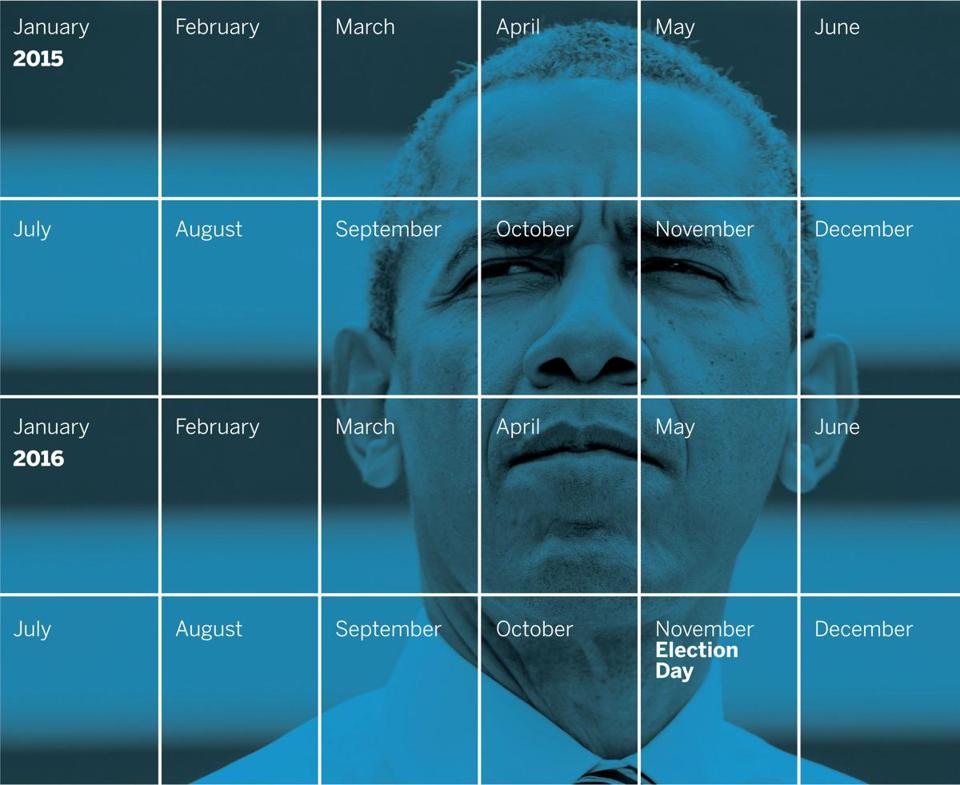
Time is running short. Obama has only two more years in office, and an oppositional Congress that will likely block any major domestic policy initiatives. But the president’s opening with Cuba raises a question. What other foreign-policy rabbits might this lame-duck president try to pull out of his hat?
Obama often talks about the arc of his history and his legacy. And we know from history that presidents in the sunset of their terms often turn their focus to foreign policy, where they have a freer hand. The presidential drift abroad has been even more pronounced in administrations that face an opposition Congress and limited support for any ambitious domestic agenda items.
Despite keeping his promises to end two wars and to reestablish America’s power to persuade, not just coerce, Obama has drawn some scorn as a foreign policy president. Poobahs across the spectrum from right to left have derided him for not having a policy (drifting on Syria, passively responding to the Arab Spring), for naively pursuing diplomacy (the reset with Russia, the pivot to Asia), for adopting his predecessor’s militarism (the surge in Afghanistan, the war on ISIS).
But, free from any future elections, the president may finally be at liberty to engineer bigger symbolic moves, like the recent rapprochement with Cuba. He can even try for politically unpopular policy realignments that would ultimately benefit his successor.
So what bold gambits might Obama reach for in his final two years? We’re talking here about unlikely developments, but ones that, with a push from a willing White House, could actually happen. Here’s a look at what might be on Obama’s wish list, and his real chances of grabbing any of these wonky Holy Grails.
A stand on torture
IN ITS WAR ON TERROR, America adopted a number of tactics that its leaders used to call un-American. Some of them appear here to stay, like remote-control bombing runs by robot planes (known by the anodyne moniker “drone strikes”), which have killed more than 2,400 people and have become the most common way Obama pursues suspected militants in Pakistan, Afghanistan, and Yemen.
But other tactics have lingered long after the White House has concluded they are counterproductive: most notably the use of torture, and the indefinite detention of enemies without charge or trial in the limbo prison at Guantanamo Bay. President George W. Bush, toward the end of his term, backtracked on both policies, quietly roping in the use of torture and exploring ways to shut down Gitmo. Obama has taken a more assertive moral stance on the issue, perhaps because he realized that America’s treatment of detainees delivered a propaganda boon to its enemies—and increased the risk of similar mistreatment for American detainees. But though he ended torture, he hasn’t settled the political debate, nor has he managed to close Guantanamo Bay.
This is one problem that Obama could resolve by fiat, if he were willing to deal with the inevitable political yelps. He could close Guantanamo Bay overnight, sending dangerous detainees to face trial in the United States, shipping others to allied states like Saudi Arabia, and releasing the rest (many of whom have spent more than a decade incarcerated). To those who would accuse him of putting America at risk by not detaining accused terrorists without charge forever, Obama could point to the US Constitution and shrug his shoulders. As for torture, some believe the best move would be to follow the South African model of a truth commission that airs all the grisly details, while granting immunity from prosecution to those who testify. Of course, critics of torture would decry the amnesty, and supporters would decry the release of narrative details.
Harvard political scientist Stephen Walt says to forget the truth commission. The simplest way for Obama to end one of the most contentious debates in America, he argues, is with a set of sweeping pardons for all those involved in torture. That could include officials from Bush on down, as well as leakers like Chelsea Manning. In an e-mail, Walt said such a move would be a “game changer,” although one with odds so long that he put it in the category of “foreign policy black swans.” “I regard it as very, very unlikely, but it would be a huge step,” he said.
Presidential pardons could make clear that torture and extrajudicial detention were illegal mistakes, while simultaneously freeing whistle-blowers and closing the books on the whole affair. Obama could even wait until after the 2016 presidential election has been decided, altogether eliminating political risk.
A détente with North Korea
EPA/KCNA ; GLOBE STAFF PHOTO ILLUSTRATION
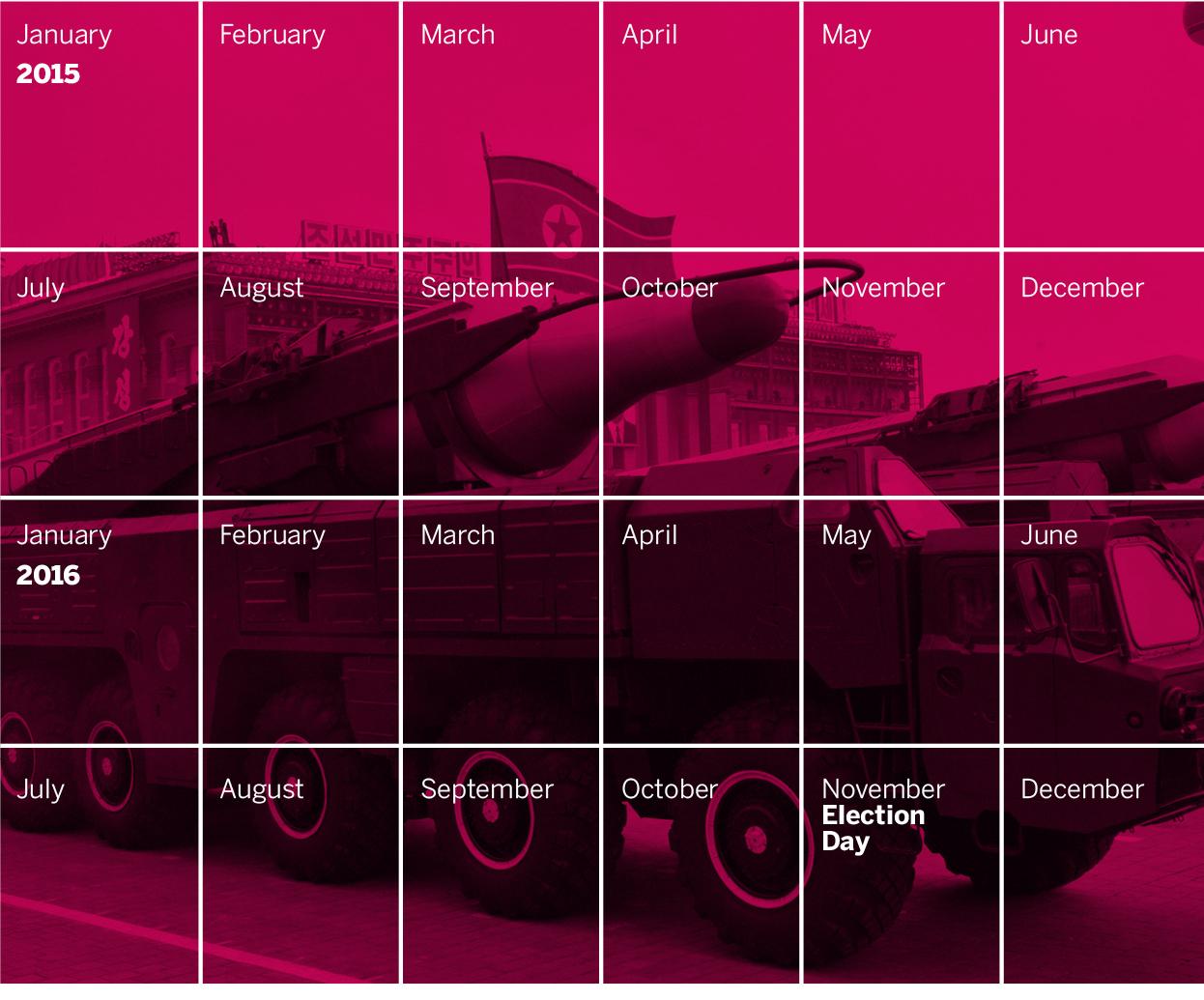
NORTH KOREA entered the news recently because of its alleged role in the Sony hack over the silly film “The Interview.” But the hermit kingdom isn’t a problem because of its leader Kim Jong-un’s absurd cult of personality. No, North Korea poses a problem because it’s a belligerent, opaque, hyper-militarized state that stands outside the international system and is armed with serious rockets, nuclear warheads, and a powerful military.
One fraught area remains the demilitarized zone between North and South Korea. About 30,000 American personnel are deployed there, and North Korea routinely provokes deadly clashes to remind the world of its resolve.
If Obama could finally end the Korean war—officially just in a cease-fire since 1953—he would resolve the most dangerous flashpoint in Asia and perhaps the world. Kim Jong-un, like his father and grandfather, has an almost mythic status among villainous world leaders. Millions have suffered in North Korea’s prison camps, and the militarized state maintains a hysterical level of propaganda that makes it stand out even among other “rogue” states. Even China, long the dynasty’s primary backer, has begun to express irritation with North Korean’s volatility.
But all this creates an opportunity, according to veteran Korea watchers. “There’s an opportunity, oddly enough,” says Barbara Demick, author of “Nothing to Envy: Ordinary Lives in North Korea.” “It would require a bold gesture on somebody’s part.”
Kim Jong-un, third in the family dynasty, has lived abroad and appears more open-minded than his father, Demick says. More importantly, despite the anti-American rhetoric, North Korea might want to end its comparatively young feud with the United States, which dates only to the 1950s, to better protect itself from the local threat from its millennial rival China.
Earlier efforts at reconciliation in the early 1990s foundered and collapsed after Kim Jong-il cheated on an agreement to freeze his nuclear weapons program. Demick and other experts are more hopeful that his son will be more interested in negotiating. Three years after taking over, Kim Jong-un seems to have consolidated power. He has relaxed some control over private trade, and he executed a senior member of his own regime who was considered China’s man in Pyongyang, asserting himself over rivals within his family and government.
“Unlike his father, Kim Jong-un doesn’t seem to want to spend his whole life as the head of a pariah state,” Demick says.
It’s quite difficult to imagine North Korea doing an about face and becoming a friendly US ally in Asia, but surprising things have happened. Vietnam, just a few decades after its horrifying war with the United States, is now as warm to Washington as it is to Beijing. Obama could try to end one of the world’s longest lingering hot wars by forging a peace treaty with Pyongyang.
A grand bargain with Iran
AMERICA’S RELATIONSHIP with Iran never recovered from the trauma of the US embassy takeover and hostage crisis of 1980. Iran, flush with oil cash and the messianic fervor of Ayatollah Khomeini’s revolution, has been at the center of regional events ever since. Iran has been perhaps the most influential force in the Arab world, helping to form Hezbollah, prop up the Assad dictatorship in Syria, and foiling America’s plans in Iraq.
Of late, attention has focused on negotiations over Iran’s nuclear program, but that’s arguably not the most problematic aspect of Iran’s power in the region. A regional proxy war between two Islamic theocracies awash in petrodollars—Shia Iran and Sunni Iraq—has contaminated the entire Arab world. Resolving Iran’s major grievances and reintegrating it into the regional security architecture would reduce tensions in several ongoing hot wars and dramatically reduce risks across the board.
Obama could seek an overall deal with Iran, in which Tehran and its Arab rivals would agree to separate spheres of influence in the region and the United States could reopen its embassy. A Tehran-Riyadh-Washington accord could signal a major realignment in the region and a move toward a more stable state order, and is actually possible—not likely, but possible.
The big protagonists here, Iran and Saudi Arabia, lose a lot of money in their proxy fighting. It’s been 35 years since the 1979 Iranian revolution that brought the ayatollahs to power, and both sides—Riyadh’s Sunni theocrats and Tehran’s Shia ones—have learned that no matter what human and financial resources they pour in, they can’t achieve regional hegemony. Eventually, they’re going to have to coexist. Israel, meanwhile, has maintained a fever pitch about Iran, and should welcome a calming shift.
The trick for today’s White House is what’s going on internally in Iran. “My sense is that if Obama and Kerry could push a button and normalize relations with Iran they’d do so in a heartbeat,” says Karim Sadjadpour, who studies Iran at the Carnegie Endowment for International Peace. “The biggest obstacle to normalization is not in Washington, it’s in Tehran. When your official slogan for 35 years is ‘Death to America,’ it’s not easy to make such a fundamental shift.” But if Iran’s president can find a way to de-fang the hard-liners in his own country, Sadjadpour believes, there’d be a strong constituency among the political elites in Iran and the United States for a grand bargain.
A step back from Israel
PRESIDENT AFTER presidenthas poured time and energy into a Middle East peace process that never works. Failures have cost America political prestige around the world. As more governments lose patience with the continuing Israeli occupation of Palestinian territory, America has found itself defending the Israeli government at the United Nations even as the same Israeli government openly mocks Washington’s agenda.
The bold move that the president could make—potentially changing the parameters of the Israeli-Palestinian conflict—would be not to invest more in some new variant of the peace process, but simply to care less. Cooling our relations with the Israeli government could reestablish the strategic calculations at the core of the relationship and remove the distracting secondary issues that have accumulated around it. Israel is one of America’s closest military and economic allies, and the tightly woven relationship will survive a political shift. Obama could simply announce that the United States would no longer act as Israel’s main international political advocate, and that we would be happy to let other actors try to negotiate agreements, as the Norwegians did in the early 1990s.
Such a move would not resolve the Israeli-Palestinian conflict, but it would go a long way toward reducing costs for the United States. Washington doesn’t need to own the baggage of its close allies. It could treat Israel like it treats the United Kingdom: as a special ally with extra privileges, but one whose bilateral conflicts are its own business.
“I realize that a president’s hands are tied by Congress when it comes to Israel, but there is plenty that the president can do without congressional approval,” says Diana Buttu, a lawyer and former adviser to the Palestinian Authority. She said that Obama has plenty of options, from using his bully pulpit to condemn Israeli actions to not blocking Palestinian UN resolutions.
Duke political scientist Bruce Jentleson suggests another kind of US surprise: incorporating Hamas into peace talks. “A delicate dance no matter what,” he wrote in an e-mail. “But Middle East peace breakthroughs have usually been through the unexpected,” like Egyptian President Anwar Sadat’s trip to Jerusalem, or the secretly negotiated Oslo Accords.
What Jentleson says of Middle East breakthroughs may well be true of other ones as well. Global politics never loses its capacity to catch us off guard, regularly delivering events that experts say are impossible. Only an inveterate optimist would bet money on any of these slim possibilities coming to pass. But only a fool would be certain that they won’t.
What failed negotiations teach us

[Originally published in The Boston Globe Ideas.]
ROCKETS AND MORTARS have stopped flying over the border between Gaza and Israel, a temporary lull in one of the most intractable, hot-and-cold wars of our time. The hostilities of late November ended after negotiators for Hamas and Israel—who refused to talk face-to-face, preferring to send messages via Egyptian diplomats—agreed to a rudimentary cease-fire. Their tenuous accord has no enforcement mechanism and doesn’t even nod to discussing the festering problems that underlie the most recent crisis. Both sides say they expect another conflict; experience suggests it’s just a question of when.
Generations of negotiators have cut their teeth trying to forge a peace agreement between Israel and the Palestinians, and their failures are as varied as they are numerous: Camp David, Madrid, the Oslo Accords, Wye River, Taba, the Road Map. For diplomats and deal-makers around the world—even those with no particular stake in Middle East peace—Israel and Palestine have become the ultimate test of international negotiations.
For Guy Olivier Faure, a French sociologist who has dedicated his career to figuring out how to solve intractable international problems, they’re something else as well: an almost unparalleled trove of insights into how negotiations can go wrong.
For more than 20 years, Faure has studied not only what makes negotiations around the world succeed, but how they break down. From Israel and the Palestinians to the Biological Weapons Convention protocol to the ongoing talks about Iran’s nuclear program, it’s far more common for negotiations to fail than to work out. And it’s from these failures, Faure says, that we can harvest a more pragmatic idea of what we should be doing instead. “In order to not endlessly repeat the same mistakes, it is essential to understand their causes,” he says.
***
TODAY’S INTERNATIONAL order turns on successful negotiation. When we think about what’s right in the world, we’re often thinking about the results of agreements like the START treaties, which ended the nuclear arms race between the United States and the Soviet Union; the Geneva Conventions, which govern the conduct of war; or even the General Agreement on Tariffs and Trade, drafted in 1948, which still underpins globalized free trade.
But in negotiations over the most vexing international problems—a hostage situation, a war between a central government and terrorist insurgents, a new multinational agreement—such successes are few and far between. Failure is the norm. Understandably, experts tend to focus on the wins. From US presidents to obscure third-party diplomats, negotiators pore over rare historical successes for tips rather than face the copious and dreary overall record.
Faure wants to change that focus. As an expert he straddles two worlds: He studies diplomacy academically as a sociologist at the Sorbonne, in Paris, and has also trained actual negotiators for decades, at the European Union, the World Trade Organization, and UN agencies. Over his career, he has produced 15 books spanning all the different theories behind negotiation, and ultimately concluded that negotiations that failed, or simply sputtered out inconclusively, were the most interesting. Each failure had multiple causes, but it was possible to compile a comprehensive list, and from that, consistent patterns.

“Unfinished Business” takes a look at what happened during a number of high-profile failures, and examines the underlying conditions of each set of talks: trust, cultural differences, psychology, the role of intermediaries, and outsiders who can derail negotiations or overload them with extraneous demands.
One of Faure’s insights concerns the mindset of negotiators—a factor negotiators themselves often believe is irrelevant, but which Faure and his colleagues believe can often determine the outcome. Incompatible values on the two sides of the table, he says, are much harder to bridge than practical differences, like an argument over a boundary or the mechanics of a cease-fire. As Faure says, “A quantity can be split, but not a value.” This is what Faure saw at work when the Palestinians and Israelis embarked on a rushed negotiation at the Egyptian seaside resort of Taba during Bill Clinton’s final month in office. The two sides had already reached an impasse at a lengthier negotiation in 2000 at Camp David. With the end of his presidency looming and Israeli elections coming up, Clinton summoned them back to the table for a no-nonsense session he hoped would bring speedy closure to disputes over borders, Jerusalem, and refugees. The Palestinians, however, felt that the two sides simply didn’t share the same view of justice and weren’t truly aiming at the same goal of two sovereign states—and so didn’t feel driven to make a deal. That mismatch of long-term beliefs, Faure says, doomed the talks.
There are other warning signs that emerge as patterns in failed talks. Time and again, parties embark on tough negotiations already convinced they will fail—a defeatism that becomes a self-fulfilling prophesy. In interviewing professional negotiators, Faure and his colleagues found that they often don’t pay that much attention to the practical aspects of how to run a negotiation—a surprising lapse.
Faure and his team have found that a well-planned process is one of the best predictors of success, and that many negotiations are terrible at it. When the European Union and the United States talked to Iran about its nuclear program, various European countries kept adding extraneous issues to the talks, for instance linking Iran’s behavior with nukes to existing trade agreements. The additions made the negotiations unwieldy, and provoked crises over matters peripheral to the actual subject. In the case of the mediation over Cyprus, the Greek and Turkish sides didn’t bother coming up with any tangible proposed solution to negotiate over, instead talking vaguely about a Swiss model. Negotiations failed in part because neither side knew what that would mean for Cyprus.
Ultimately, Faure argues, mistrust and inflexibility tangle up negotiators more than any other factor. Negotiators often end up demonizing the other side, and as a result might embark on a process that by its structure encourages failure. For instance, Israeli and Palestinian reliance on mediators to ferry messages—even between delegations in the same resort—maximizes misunderstandings and minimizes the possibility that either side will sense a genuine opening.
***
WHAT EMERGES FROM Faure’s work, overall, is that the outlook for negotiations is usually pretty bleak—certainly bleaker than Faure himself prefers to highlight. In some cases, he suggests that diplomats should put off an outright negotiation until they’ve dealt with gaps in trust and cultural communication, or until the conflict feels “ripe” for solution to the parties involved. There’s no point, he suggests, in embarking on a negotiation if all the stakeholders are convinced it’s a waste of time—indeed, a failed negotiation can sometimes exacerbate a problem.
The most promising scenarios occur when both sides are suffering under the status quo, which creates what social scientists call a “mutually hurting stalemate,” with soldiers or civilians dying on both sides, and a “mutually enticing opportunity” if there’s a peace agreement or a prisoner swap. In that case, a decent deal will give both sides a chance to genuinely improve their lot.

Unfortunately for the many whose hopes are riding on negotiations, the truly challenging international problems of our age don’t always come with a strong incentive to compromise. In military conflicts, there is little incentive to resolve matters when a conflict is lopsided in one side’s favor (Shia versus Sunni in Iraq, Israel versus Hamas, the Taliban versus the United States in Afghanistan). The same holds in broader international agreements: They’re complicated and intractable largely because the states involved are—no matter what they say—quite comfortable with the status quo. Think about climate change: The biggest gas-guzzlers and polluters, the ones whose assent matters the most for a carbon-reduction treaty, are often the last states that will pay the price for rising oceans. Meanwhile, the poorer nations whose populations are most at the mercy of sea levels or changing weather have little clout. Just as it’s easy for a relatively secure Israel to stand pat on the Palestinian question, there are few immediate consequences for the United States and China if they sit out climate talks.
It’s not all bleak news. Even in cases where negotiations appear hamstrung—like climate change and Palestine—there are, Faure points out, plenty of other reasons to continue negotiating. Negotiations are a form of diplomacy, dialogue, and recognition, and even in failure can serve some other interests of the parties involved. But—as the impressive historical record of failed international agreements shows—it’s naive to think that they will always yield a solution.
Not an Ally, Not an Enemy
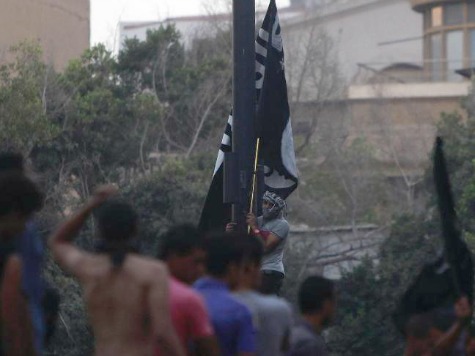
President Obama struck a powerful chord last night when asked about Egypt’s tepid response to the incursion on the American Embassy in Cairo. “I don’t think that we would consider them an ally, but we don’t consider them an enemy,” Obama told Telemundo. The American president’s pointed observation balanced the need to put Egypt on notice against the importance, in diplomacy, of not sounding like a scold.
In this case, Egypt’s president Mohamed Morsi has behaved like a recalcitrant populist, trying to benefit domestically from anger over a private American film that insulted Islam, while not losing any of America’s vital support for Egypt. Perhaps Morsi has read recent Egyptian history and concluded that Cairo’s support is so important that Washington will bear any humiliation in order to retain the special military and security relationship. Yet all international relations have their limits; and Morsi might have forgotten that America accepted a great amount of bad behavior by the SCAF during the 18-month transitional period that followed Mubarak’s fall — but now we’re dealing with an elected sovereign government with a popular mandate and popular accountability. This is the real thing, a democratically governed Egypt. Its president is now responsible for his behavior and for his country’s policy.
In a chat yesterday on Capital New York, I said that Obama would need to pointedly express America’s anger toward Egypt.
Don’t get me wrong: he needs to “engage” the Brotherhood, which means, “have relations” with it. In this case, the engagement should consist of a cold, angry, demand: that they immediately condemn the invasion of the embassy grounds, and that they act responsibly to cool anti-American sentiment—if they expect our financial aid, our military aid, and our indispensable support in getting the IMF and other international assistance vital to Egypt’s economic survival. … I think it will hurt Obama if he doesn’t criticize Egypt aggressively, and in public. And I think the damage could grow if people connect these breaches to America’s broader directionless in the wake of the Arab uprisings.
That’s the real problem, by the way—not the stuff Romney is bringing up.
Obama might finally be making some progress, a year and a half late, in coining a coherent response to the Arab uprisings. His comments about Egypt suggest that Washington is mature and wise enough to begin navigating that gray area between subservient client state and outright enemy; most of the post-uprising Arab world will fall somewhere in that confusing terrain that houses most sovereign states, neither “with us” nor “against us.”
America is contemplating an Egypt that won’t march in lockstep with all its interests. Egypt doesn’t want to go to war with Israel for its own reasons, but it’s likely to be much more hostile and less cooperative there. Same on defense and counter-terrorism. Cairo and Washington will have to negotiate their limited shared interests. The flip side, however, might not yet have dawned on Egypt’s new leaders; America is under no obligation to underwrite Egypt’s military and to a lesser degree is economy with no-strings-attached billions. An independent Egyptian government (or depending on your perspective, an irritating one) will surely be a boon to Egypt’s sense of honor, pride, and autonomy. But it won’t come without consequences. Angering an American government, even a patient one, still carries costs.
A World of Messy Borders? Get Used to It
[Originally published in The Boston Globe Ideas section.]
 The primacy of sovereign nations, in the long view, is a recent development of history. In Europe, before the Peace of Westphalia, the continent’s city-states competed with larger kingdoms and the Holy Roman Empire in a perpetual violent struggle for territory and resources. It was hard to distinguish among different kinds of authority. In some places, the pope held sway; in others, a monarch; in still others, a family or group of families whose power stemmed less from their territory than from the wealth they created through commerce or industry.
End the Addiction to Stability
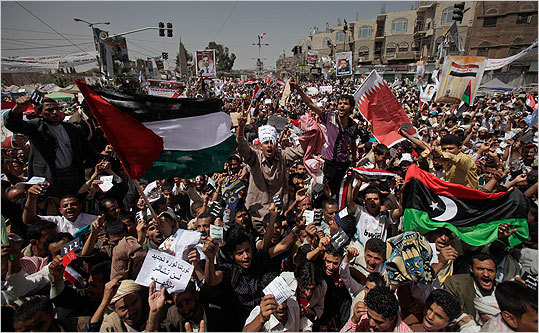
An obsession with “stability” — and an erroneous, narrow definition of the term — has warped American foreign policy, especially in the Middle East. Washington’s struggle to adjust to the rapid transformation of the region in part reflects a calcified mindset that for decades had to account for little change. Now, with the Arab political landscape barely recognizable, American policymakers are trying to adjust quickly. Imagine, American client regimes toppling one by one, while absolute monarchies in the Gulf are taking part in military interventions to unseat one dictator in Libya while propping up another in Bahrain. Some people will argue that all this turmoil amounts to an even stronger argument for stability; I’d say events suggest the opposite. That’s the subject of my latest Internationalist column in The Boston Globe.
America’s main goals in the Middle East have remained constant at least since the Carter years: We want a region in which oil flows as freely as possible, Israel is protected, and citizens enjoy basic human rights — or at least aren’t so unhappy that they begin to attack our interests.
In working toward these goals, the byword and the cornerstone of the entire venture has been stability. Washington has invested heavily — with money, weapons, and political cover — to guarantee the stability of supposedly friendly regimes in places like Egypt, Saudi Arabia, and Jordan. The idea is simple: A regime, even a distasteful and autocratic one, is more likely to help America, and even to treat its own people with a modicum of decency, if it doesn’t feel threatened. Instability creates insecurity, the thinking goes, and insecurity breeds danger.
But the unrest and dramatic changes of the past months are offering a very different lesson. An overemphasis on stability — and, perhaps, an erroneous definition of what “stability” even is — has begun harming, rather than helping, American interests in several current crisis spots. Our desire to keep a naval base in a stable Bahrain, for example, has allied us with the marginalized and increasingly radical Bahraini royal family, and even led us to acquiesce to a Saudi Arabian invasion of the tiny island to quell protests last month. To keep Syria stable, American policy has largely deferred to the existing Assad regime, supporting one of the nastiest despots in the region even as his troops have fired live ammunition at unarmed protesters. In a moral sense, this “stability first” policy has been putting America on the wrong side of the democratic transitions in one Arab country after another. And in the contest for pure influence, it is the more flexible approaches of other nations that seem to be gaining ground in such a fast-changing environment. If we’re serious about our goals in the Middle East, “stability” is looking less and less like the right way to achieve them.
Foreign policy shifts slowly, and it’s hard to replace such a familiar, if flawed, approach to the world. But recent events have strengthened the ranks of thinkers who argue that there may be more effective and less costly ways to press our interests in the Middle East. We could take an arm’s length approach, allowing that not every turn of the screw in the Middle East amounts to a core national interest for the United States — in effect, abstaining from some of the region’s conflicts so we have more credibility when we do intervene. We could embrace a more dynamic slate of alliances that allows the United States to shift its support as regimes evolve or decay. Finally, we could redefine stability entirely and downgrade it as a priority, so that we recognize its value as simply one of many avenues toward achieving US interests.
Read the rest in The Boston Globe.
Some Lessons of the Arab Revolts
In my latest Internationalist column for The Boston Globe, I explore some of the implications of the Arab revolutions for US policy. It will take a long time for American policy makers to grasp the implications of the popular wave sweeping the Arab world, and if history is any guide, the architects of American policy might never actually figure out what happened, why, and how best to respond. One of my favorite analysts and bloggers, Issandr El Amrani at The Arabist, thinks the arguments I make are at best banal, at worst, completely wrong-headed.
Here’s how the column opens:
The popular revolts in Tunisia, Egypt, Libya, and beyond have seized the world imagination like no events since the collapse of the Iron Curtain. Regimes are teetering, dictators have fallen, and unexpected coalitions have managed to conjure street-level power seemingly out of thin air. Tunisians took credit for Egypt’s revolution; Egyptian demonstrators in turn claim they inspired people in Wisconsin and Bahrain.
Much remains uncertain, and even the most experienced observers have no idea who will hold power in the aftermath of these uprisings. But already we’ve learned more in a few short months than we gleaned from decades of careful study about the real power base of Moammar Khadafy and Hosni Mubarak, about the balance among armies and tribes, about the relative power of secular and Islamist activists. We’re seeing the true measure of oil money and the Muslim Brotherhood, of popular anger about corruption, and of the real interest in economic liberalization.
But perhaps the most surprising lessons emerging from all the unrest are even bigger ones — insights that extend well beyond the Middle East, and are forcing thinkers and policy makers to reconsider some basic assumptions that have long guided America’s foreign policy. How much impact can America really have on world events? How do our alliances function at crucial moments? Who really has the potential to initiate and control massive change in modern societies? The surprising answers suggested by the Arab revolts might create new options in the minds of American policy makers looking to advance not only US security and economic goals, but also the causes of human rights, transparency, and democratic governance.
Talk to Terrorists
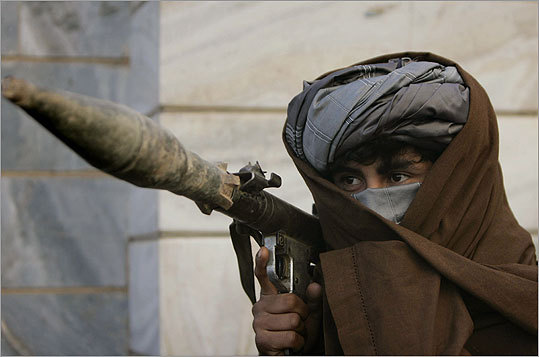 The Internationalist, my new monthly column about foreign affairs, debuted today in The Boston Globe Ideas section. The opening column explores the views of a cohort I call “engagement hawks,” who offer a pragmatic, utilitarian critique of the traditional argument that negotiating with terrorists makes us weaker. These thinkers and practitioners have articulated an intellectual critique of America’s historical position, and have tried to extract lessons from America’s sometimes-bumbling experiences since the Cold War reconciling — or trying and failing to do so — with enemies it has labeled “terrorists.”
Ronald Reagan framed the debate over whether to talk to terrorists in terms that still dominate the debate today. “America will never make concessions to terrorists. To do so would only invite more terrorism,” Reagan said in 1985. “Once we head down that path there would be no end to it, no end to the suffering of innocent people, no end to the bloody ransom all civilized nations must pay.”
America, officially at least, doesn’t negotiate with terrorists: a blanket ban driven by moral outrage and enshrined in United States policy. Most government officials are prohibited from meeting with members of groups on the State Department’s foreign terrorist organization list. Intelligence operatives are discouraged from direct contact with terrorists, even for the purpose of gathering information.
President Clinton was roundly attacked when diplomats met with the Taliban in the 1990s. President George W. Bush was accused of appeasement when his administration approached Sunni insurgents in Iraq. Enraged detractors invoked Munich and ridiculed presidential candidate Barack Obama when he said he would meet Iran and other American adversaries “without preconditions.” The only proper time to talk to terrorists is after they’ve been destroyed, this thinking goes; any retreat from the maximalist position will cost America dearly.
Now, however, an increasingly assertive group of “engagement hawks” — a group of professional diplomats, military officers, and academics — is arguing that a mindless, macho refusal to engage might be causing as much harm as terrorism itself. Brushing off dialogue with killers might look tough, they say, but it is dangerously naive, and betrays an alarming ignorance of how, historically, intractable conflicts have actually been resolved. And today, after a decade of war against stateless terrorists that has claimed thousands of American lives and hundreds of thousands of foreign lives, and cost trillions of dollars, it’s all the more important that we choose the most effective methods over the ones that play on easy emotions.
New York, Viewed from the Rest of the World
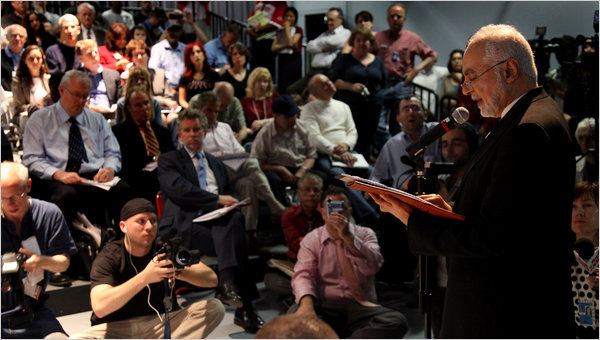 I’ve spent much of the last week covering the Park51 story from the Arab world. The entire affair has attracted far less attention in the Islamic world than one might expect. We put together a story that canvassed global reaction in today’s Times.
If the project’s organizers move the site, or cancel it altogether, I’d expect stronger opinions than we’ve seen so far. Same if there’s a major shift in public opinion, or a spate of violent attacks, or nastier rhetoric than we’ve seen so far.
For more than two decades, Abdelhamid Shaari has been lobbying a succession of governments in Milan for permission to build a mosque for his congregants — any mosque at all, in any location.
For now, he leads Friday Prayer in a stadium normally used for rock concerts. When sites were proposed for mosques in Padua and Bologna, Italy, a few years ago, opponents from the anti-immigrant Northern League paraded pigs around them. The projects were canceled.
In that light, the furor over the precise location of Park51, the proposed Islamic community center in Lower Manhattan, looks to Mr. Shaari like something to aspire to. “At least in America,” Mr. Shaari said, “there’s a debate.”
Across the world, the bruising struggle over an Islamic center near ground zero has elicited some unexpected reactions.
For many in Europe, where much more bitter struggles have taken place over bans on facial veils in France and minarets in Switzerland, America’s fight over Park51 seems small fry, essentially a zoning spat in a culture war.
But others, especially in countries with nothing similar to the constitutional separation of church and state, find it puzzling that there is any controversy at all. In most Muslim nations, the state not only determines where mosques are built, but what the clerics inside can say.
The one constant expressed, regardless of geography, is that even though many in the United States have framed the future of the community center as a pivotal referendum on the core issues of religion, tolerance and free speech, those outside its borders see the debate as a confirmation of their pre-existing feelings about the country, whether good or bad.
The “Ground Zero” Imam
 Imam Feisal Abdul Rauf, leader of the Park51 project (you know, the Islamic community center in Lower Manhattan), kept quiet about the controversy back home during his visit to Bahrain this week. He was on a US State Department trip promoting interfaith dialogue, tolerance, and his long-running project to inject his philosophy of adaptable American Islam into the worldwide Islamic debate. Initially, the State Department tried to shield the imam from publicity, but eventually relented – slightly – by making public one event in each of the three countries Imam Feisal is visiting.
In Bahrain, I managed to secure my own invite to the majlis of Sheikh Salah al-Jowder. He’s an oddity, a moderate salafist who sits on an interfaith dialogue committee in Manama (it’s interesting that such a thing even exists). There, Imam Feisal talked a bit about the center, because his hosts had a lot of questions.
The latecomers to Sheik Salah al-Jowder’s majlis, or weekly assembly, wished peace upon their cousins and shook all the men’s hands before sitting down on the deep striped sofas that lined the oblong reception hall.
Imam Feisal Abdul Rauf, leader of the planned Park51 Islamic community center in Lower Manhattan, was sipping Arabic coffee about an hour before midnight Sunday in Muharraq, a crowded neighborhood near the international airport.
On the first stop of his good-will tour, sponsored by the State Department, Mr. Abdul Rauf talked expansively about religious law, the lessons of Islamic history and his mission to build bridges between the West and the Islamic world — any topic, it seemed, but the controversy that lately has made him famous.
About 20 Bahraini men, in flowing white robes and headdresses held in place with braided leather bands, fiddled with their BlackBerrys, drank coffee and fingered beads.
After Mr. Abdul Rauf had spoken, and exchanged pleasantries with his hosts, one of the Jowder cousins raised his voice.
“I know you have the support of President Obama,” he said, almost shouting to be heard over the air-conditioners. “But why don’t we just change the place, to show that Islam is not there to threaten everybody, that Islam is a religion of peace?”
Imam Feisal is in Qatar now, and will visit the United Arab Emirates before returning to the U.S. in early September. He said he will talk to the American media then. For now, he insists, he wants to focus on the Cordoba Initiative’s outreach project.
A lot of his most controversial ideas – at least in the Islamic world – have to do with his belief that Islam takes a different shape in every host culture. American Islam, Imam Feisal argues to his audiences in the Islamic world, has just as much religious legitimacy as Egyptian Islam, or Persian Gulf Islam, or Malaysian Islam, and so on. He makes his argument quietly, but it’s a position that runs squarely counter to the trends in the Arab world toward a more orthodox view of Islam. Imam Feisal believes that Muslims in Egypt can learn from the way American Muslims interpret their faith, and not just vice versa.
For a sense of those ideas and their origin, you can read Anne Barnard’s fabulous profile of Imam Feisal (on which I collaborated from Cairo). She also parses some of the claims about him circulating in the blogosphere.
Britain Reconsidering Hezbollah Channel?
 In a recent interview with Asharq Alawsat, the United Kingdom’s new Conservative Minister for the Middle East Alistair Burt said that Britain was reconsidering its policy of limited relations with Hezbollah. In 2008, after a three-year hiatus, the British Foreign Office quietly resumed its policy of allowing diplomats to talk to Hezbollah’s “political wing,” making a distinction between the organization’s political and military sides that Hezbollah itself does not.
Burt didn’t say the U.K. would cut off the limited dialogue between its diplomats and Hezbollah’s elected members of parliament, but that the British government would review all future contacts:
It is still too early to say if we are going to adopt the approach of the previous government with regards to distinguishing between the political and military wings of Hezbollah. … There may be occasions where limited communication would be in everybody’s interests and the interests of the peace process in general. However we will place such communication under constant review, and on a case by case basis.
The British Labor government kept more open channels with Middle Eastern militants than the United States has, at times drawing rebukes from Washington. It will be interesting to see whether the new Conservative government continues the same approach.
Terrorist Talkers
 It’s a banner day for the topic I’ve been researching all spring : What tools beyond direct force can Western government use to engage, modulate or otherwise shape the behavior of listed terrorist groups? I’ve been studying in particular the use of intelligence community contacts, diplomacy, creative government engagement through aid and trade, and Track Two diplomacy (which we might as well call secret negotiations, since almost all of the important initiatives take place with the full knowledge of the governments involved).
In the wake of last week’s Supreme Court ruling on the material support statute, which holds that political advice amounts to assistance for terrorist groups, several advocates of off-line diplomacy have reiterated their arguments for engagement.
First comes Mark Perry, author of the book Talking to Terrorists published earlier this year. He argues that the United States, Europe and Israel gain nothing by boycotting groups like Hamas and Hezbollah, because those groups are here to stay and represent large and growing constituencies. Perry broke the story in March that General David Petraeus had told the White House that America’s pro-Israel stance was harming core national interests in the Islamic world. Now, he’s gotten his hands on another CentCom document in which he reports that some military propose that Hamas should be integrated into the Palestinian Authority security forces and Hezbollah into the Lebanese Army. Both groups, the authors of the military memo argue, should receive American military training, even though they’re defined as foreign terrorist organizations by the U.S. government. (The officers were on a so-called “Red Team” tasked with challenging assumptions and considering alternative ideas.)
The CENTCOM team directly repudiates Israel’s publicly stated view — that the two movements [Hamas and Hezbollah] are incapable of change and must be confronted with force. The report says that “failing to recognize their separate grievances and objectives will result in continued failure in moderating their behavior.”
Meanwhile, on the op-ed page of The New York Times today, the academics Scott Atran and Robert Axelrod write that informal diplomacy has played a crucial role in convincing terrorist groups to renounce violence and enter politics. They cite historical Track Two negotiations begun by private citizens in the transformation of the Palestine Liberation Organization and the Real Irish Republican Army. They also cite their own back-channel conversations with Palestinian militant groups, including Hamas and Islamic Jihad, which they said have yielded important insights.
Private citizens can talk to leaders who are off limits to policy-makers, and can report their findings; in this instance, Atran and Axelrod write, Islamic Jihad reveals itself as recalcitrant and committed to fighting Israel, whereas a Hamas leader suggested he would consider not just a truce (hudna) but peace (salaam). Atran and Axelrod caution that off-line private diplomacy requires expertise and discretion: “Accuracy requires both skill in listening and exploring, some degree of cultural understanding and, wherever possible, the intellectual distance that scientific data and research afford.”
It’s an uncomfortable truth, but direct interaction with terrorist groups is sometimes indispensable. And even if it turns out that negotiation gets us nowhere with a particular group, talking and listening can help us to better understand why the group wants to fight us, so that we may better fight it. Congress should clarify its counterterrorism laws with an understanding that hindering all informed interaction with terrorist groups will harm both our national security and the prospects for peace in the world’s seemingly intractable conflicts.
Advocates of such talks usually take care not to oversell their potential, given that talking to terrorists rarely yields quick results and frequently yields none at all, except for political fallout when secret talks are leaked. All three of these authors have written publicly about their private conversations with leaders of listed terrorist groups. Their conversations were conceived as part of a concerted effort to convince the groups in question to renounce terrorism and violence and pursue their grievances in a legitimate political forum.
It’s unclear whether the Supreme Court ruling would affect these freelance diplomats, who tend to report their foreign terrorist contacts to the government and conduct their diplomatic experiments more or less with their government’s blessing. But for now American law – and grand strategy – have perhaps intentionally left in a fuzzily defined gray area the question of what kind of engagement best complements national counter-terrorism efforts.
Can You Tell a Terrorist to Abandon Violence?
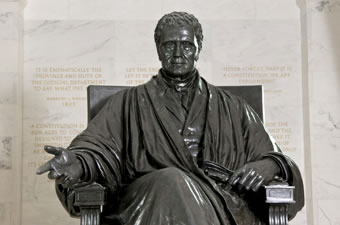 According to the U.S. Supreme Court, it appears that Americans aren’t allowed to interact with listed terrorist groups, even to provide them the kind of assistance that on its face would appear to conform precisely to American policy aims. In the case of Holder vs. Humanitarian Law Project, a group of American activists sought permission in advance before holding workshops to teach nonviolent political negotiation to a group listed as a foreign terrorist organization by the U.S. State Department. In this case, the groups involved were the Kurdistan Worker’s Party, or PKK, the militant Kurdish separatist group, and the LTTE, or Tamil Tigers, in Sri Lanka. The court ruled 6-3 that such assistance would violate American laws that prohibit providing material assistance to terrorists.
I will write at greater length about this case later, and the many complicated questions that it raises. But right off the bat, it makes me wonder:
- Are the go-betweens who take messages to listed terrorist groups and report on their meetings to U.S. diplomats now legally liable?
- What happens if a listed terrorist group wants to abandon violence and learn politics? Who is allowed to advise them?
- Do journalists violate the material support law when they interview members of listed terrorist groups and publish their statements?
- When the U.S. government sends out feelers to listed terrorist groups, using intelligence operatives or other means, are they violating the law? Or is the government itself exempt? Or is a secret presidential finding necessary?
- If teaching terrorists about human rights law is equivalent in the eyes of the law to giving money to terrorists, what are the implications for free speech? Have words and money, political speech and military donations, become indistinguishable in the eyes of the law? What further avenues of prosecution would be opened such a finding?
The Supreme Court decision is here. Read the news story and the editorial in The New York Times, and other links on the homepage of the Humanitarian Law Project.
Hamas’ Tunnel Diplomacy
 My letter from Gaza just went up on Foreign Affairs. In the piece, I describe the similar ways that Hamas has responded to economic and political isolation, in one case with tunnels, in the other case with their diplomatic equivalent. The web of tunnels underneath the Gaza-Egypt border turned an economic crisis for Gaza into a new sphere of influence for Hamas. I liken the approach — improvise and then pretend afterwards it was part of a strategic plan — to the way merchants solve problems.
Here’s the thesis:
At first, in 2007, Hamas only tolerated the tunnel economy; but it began to embrace it the following year, legalizing and regulating subterranean trade. Hamas had found a spontaneous solution to the economic crisis that was threatening its rule of Gaza — and, in the process, turned expediency into opportunity.
Opportunism as strategy appears to be the group’s new hallmark. When faced with only bad options to deal with the blockade or its status as a diplomatic pariah, Hamas has behaved as if it chose its predicament, leveraging its position into either greater control over Gaza or greater political influence beyond its boundaries. Desperation, in other words, has become an avenue to power.
Click here to read the whole piece.